AEM Cold Air Intake for the 2022–2025 Subaru WRX: What It Changes
The 2.4L turbo Subaru WRX is an easy platform to start modifying, and an intake is one of the first upgrades many owners consider. Here’s a closer look at the AEM C.A.S. Cold Air Intake, how it changes airflow and sound, what is included, and where it fits into a complete WRX build.
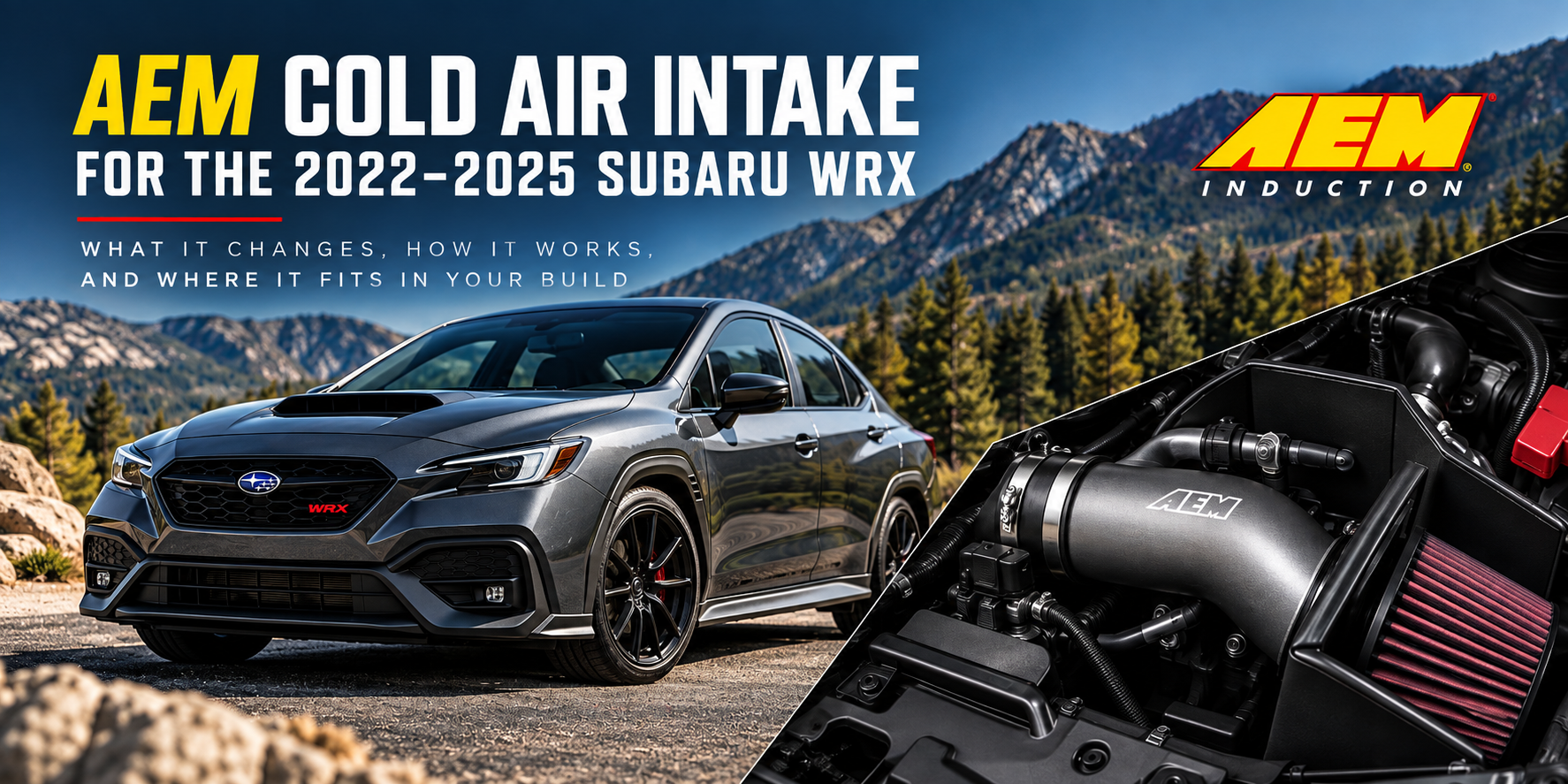
The Subaru WRX has always been the kind of car that invites modification.
It is practical enough to drive every day, turbocharged from the factory, and supported by an enormous aftermarket. For owners of the 2022–2025 WRX, one of the first questions is usually the same: where should the build start?
An intake is a logical place to look.
The AEM C.A.S. Cold Air Intake for the 2022–2025 Subaru WRX is designed specifically around the FA24 turbo platform. Rather than being a generic filter attached to a piece of tubing, it combines an oversized washable filter, mandrel-bent aluminum intake tube, and enclosed heat-shield system into a vehicle-specific package.
But what does that actually change on a WRX, and where does an intake fit into a larger performance build?
Why Is an Intake Such a Popular First WRX Upgrade?
Factory intake systems have to satisfy a long list of requirements.
They need to control noise, fit tightly inside the engine bay, work in different climates, meet manufacturing targets, and perform reliably for owners who may never modify the vehicle.
An enthusiast has different priorities.
A performance intake is typically designed around reducing unnecessary airflow restriction, increasing filter area, changing the intake path, and allowing more of the turbocharger's induction sound to reach the driver.
That makes an intake appealing because it can change the character of the car without requiring a major mechanical teardown.
Owners comparing intake options can browse the full air intake systems catalog at Elite Performance, but this AEM system is especially relevant to the current-generation WRX.
What Is the AEM C.A.S. WRX Cold Air Intake?
AEM developed this system specifically for the turbocharged 2.4-liter WRX platform.
The intake replaces key portions of the factory induction system with components designed to increase airflow while retaining a vehicle-specific installation.
The complete setup revolves around three main pieces: the filter, the intake tube, and the heat shield.
AEM Dryflow Air Filter
At the end of the intake system is an oversized AEM Dryflow filter.
The filter uses synthetic, oil-free media. That matters because maintenance does not require re-oiling the filter after cleaning.
AEM also designed the filter to be washable and reusable rather than disposable.
For a street-driven WRX, that creates a fairly simple maintenance routine: periodically inspect the filter, clean it when necessary, and reinstall it rather than replacing the entire filter element every service interval.
Mandrel-Bent Aluminum Intake Tube
The AEM system uses a mandrel-bent aluminum intake tube finished in gunmetal gray.
Mandrel bending helps maintain a smoother and more consistent tube diameter through the bends instead of sharply reducing the inside diameter of the airflow path.
That gives incoming air a cleaner path toward the turbocharger while also changing the appearance of the engine bay.
Enclosed Heat Shield
An intake cannot be judged by airflow alone.
The temperature of the air entering the system matters too.
AEM includes a shaped heat shield with a lid around the filter area. Its purpose is to help isolate the filter from some of the hot air circulating inside the engine compartment.
That distinction is important because simply placing an exposed filter inside a hot engine bay does not automatically create a better intake system.
What Does the AEM Intake Change on the WRX?
The most noticeable difference may not be a dyno number.
For many drivers, the biggest changes from an intake are the sound, engine response, and overall feel of the turbocharged powertrain.
More Turbo and Intake Sound
The factory intake system is designed to suppress a significant amount of induction noise.
Replacing portions of that system with a performance intake can make the turbocharger and incoming airflow more noticeable from the driver's seat.
You may hear more air rushing through the intake under throttle, more turbo activity as boost builds, and more of the sounds that normally stay muted behind the factory airbox.
For WRX owners who want the car to feel more mechanical and engaging without immediately installing a louder exhaust, that change alone can make an intake attractive.
Less Restrictive Airflow Path
AEM designed and dyno-tested this intake around improving airflow compared with the factory intake housing.
The larger filter and performance-oriented intake tubing are intended to allow the engine to breathe with less restriction.
That does not mean every vehicle will suddenly make a dramatic amount of additional horsepower simply because an intake was installed.
Actual results depend on the complete vehicle setup, calibration, fuel, environmental conditions, and supporting modifications.
A Cleaner Performance Engine-Bay Look
Performance parts do not have to be purely cosmetic, but there is nothing wrong with wanting an engine bay that looks better too.
The gunmetal aluminum tube, large Dryflow filter, and enclosed heat-shield assembly give the WRX engine bay a noticeably more purpose-built appearance than the factory plastic intake system.
Will an Intake Make a Stock WRX Faster?
This is where expectations matter.
A quality intake can improve airflow and support a performance build, but it should not be treated as a shortcut to massive horsepower.
A modern turbocharged engine is controlled by an ECU monitoring boost pressure, airflow, fueling, ignition timing, intake temperatures, and many other variables.
Changing one part of the airflow system does not automatically mean the engine will take full advantage of every additional bit of airflow available.
Think of the Intake as Part of a System
The better way to think about an intake is as part of the engine's complete breathing system.
Air enters through the filter and intake, moves through the turbocharger and charge-air system, enters the engine, and eventually exits through the exhaust.
As a WRX build becomes more aggressive, each portion of that system becomes more important.
An intake can therefore make sense as an early modification while also supporting future changes.
Do Not Assume Every Intake Has the Same Tuning Requirements
Modern performance cars can be sensitive to changes in the intake tract, particularly when airflow sensors and ECU calibration are involved.
Do not assume that the installation requirements for one intake apply to every intake or every stage of a build.
Always follow the manufacturer's instructions for the specific intake and confirm whether your vehicle's current calibration or other modifications create additional tuning requirements.
Who Is AEM Induction?
AEM Induction builds intake and filtration products for a wide range of performance platforms.
The brand's catalog spans everything from simple replacement performance filters to vehicle-specific cold air intake systems for turbocharged and naturally aspirated applications.
That platform-specific approach matters because intake design is highly dependent on the vehicle.
Filter placement, sensor locations, available engine-bay space, heat sources, turbo location, factory ducting, and tubing geometry all affect how an intake needs to be designed.
If you want to compare this WRX system with the rest of the brand's lineup, Elite Performance also has a dedicated collection of AEM Induction air intake systems.
Which WRX Models Does This Intake Fit?
The AEM intake listed at Elite Performance is designed for current-generation Subaru WRX applications using the 2.4-liter turbocharged engine.
Current catalog fitment covers multiple 2022–2025 WRX trims, with exact year and trim compatibility depending on the vehicle.
That includes applications across WRX Base, Premium, Limited, GT, TR, and tS configurations within the years specifically listed for each trim.
Because fitment can vary by model year and trim, confirm your exact year, model, and configuration before ordering.
You can also browse the broader Subaru WRX parts catalog to see other upgrades available for the platform.
Why Exact Fitment Matters
An intake is not a universal pipe-and-filter assembly.
The mounting points, sensors, hose connections, clearances, and heat shielding need to match the vehicle correctly.
Never force or modify a part simply because it appears close to fitting. Verify the application first.
What About Installation and Maintenance?
An intake is generally much less invasive than replacing a turbocharger, exhaust manifold, or major engine component, but proper installation still matters.
Installation
The system needs to be assembled with every coupler, clamp, sensor connection, hose, and mounting point correctly positioned.
An air leak after the airflow measurement point can create drivability problems, so intake connections should be inspected carefully after installation.
It is also worth checking the installation again after a few heat cycles to make sure clamps and mounting hardware remain secure.
Filter Maintenance
The Dryflow filter is washable and reusable.
How frequently it needs cleaning depends heavily on driving conditions. A WRX driven primarily on clean pavement will expose the filter to a very different environment than one regularly driven through dust, construction zones, or dirty conditions.
Inspect the filter rather than relying exclusively on mileage.
Where Does an Intake Fit Into a WRX Build?
The answer depends on the kind of WRX you want to build.
Daily-Driven Street WRX
For a mostly stock daily driver, an intake can be appealing because it changes the sound and personality of the car without fundamentally transforming how it is used.
You retain a practical four-door AWD car while getting more of the turbocharged character that attracted many owners to the WRX in the first place.
Street Performance Build
For a modified street car, the intake becomes one part of a larger airflow and calibration strategy.
Depending on the owner's goals, future upgrades might include intercooling, exhaust components, engine management, suspension, brakes, or drivetrain improvements.
The important part is choosing modifications that work together instead of collecting unrelated parts.
Higher-Power WRX
As power goals rise, supporting systems matter more.
A high-output turbocharged car needs sufficient airflow, charge-air cooling, fueling, engine management, and heat control.
An intake alone does not create that package, but a properly designed intake becomes one piece of the complete system.
What Should You Consider Before Buying?
Before ordering any WRX intake, ask a few basic questions.
- Does the part fit your exact model year and trim?
- What are the manufacturer's tuning recommendations?
- Is the vehicle stock or already modified?
- Are you primarily looking for sound, airflow, future upgrade support, or all three?
- Are there emissions restrictions where the vehicle is registered or driven?
- Are you comfortable maintaining a reusable performance filter?
Check Emissions Requirements
The AEM 21-891C listing is not currently marked as CARB approved.
That matters for vehicles operated in California and potentially other jurisdictions with emissions-related aftermarket restrictions.
Always check the current product listing and applicable local regulations before purchasing or installing emissions-related performance equipment.
Is the AEM WRX Intake Worth Considering?
If you own a 2022–2025 WRX and want one of the first modifications to change both the engine bay and the driving experience, this AEM system is worth putting on the shortlist.
It combines a vehicle-specific intake path, mandrel-bent aluminum tubing, an oil-free washable Dryflow filter, and an enclosed heat-shield design in one package.
More importantly, it fits naturally into the way many WRX builds develop.
You can start with a relatively simple airflow upgrade and then build around it as your goals become clearer.
For some owners, that means keeping the rest of the car close to stock and simply enjoying more intake and turbo sound. For others, it becomes the beginning of a larger street-performance project.
The key is matching the part to the build instead of modifying the car just for the sake of adding parts.
Build Your WRX With a Plan
The best performance builds are rarely created by installing everything at once.
They develop one system at a time.
An intake can be a sensible first step because it introduces you to the airflow side of the WRX platform while leaving plenty of room for future upgrades.
If the AEM system matches your goals, you can view the AEM 2022–2025 Subaru WRX Cold Air Intake at Elite Performance, or explore more performance parts for your WRX before deciding where the build goes next.