APR Roll-Control Coilovers: How to Dial In Your MQB Street or Track Build
The APR Roll-Control Coilover System gives Volkswagen and Audi enthusiasts control over ride height, damping, spring preload, and front camber. Here’s how those adjustments work, what they actually change, and how to set up an MQB or MQB EVO car for street, track, or mixed use.
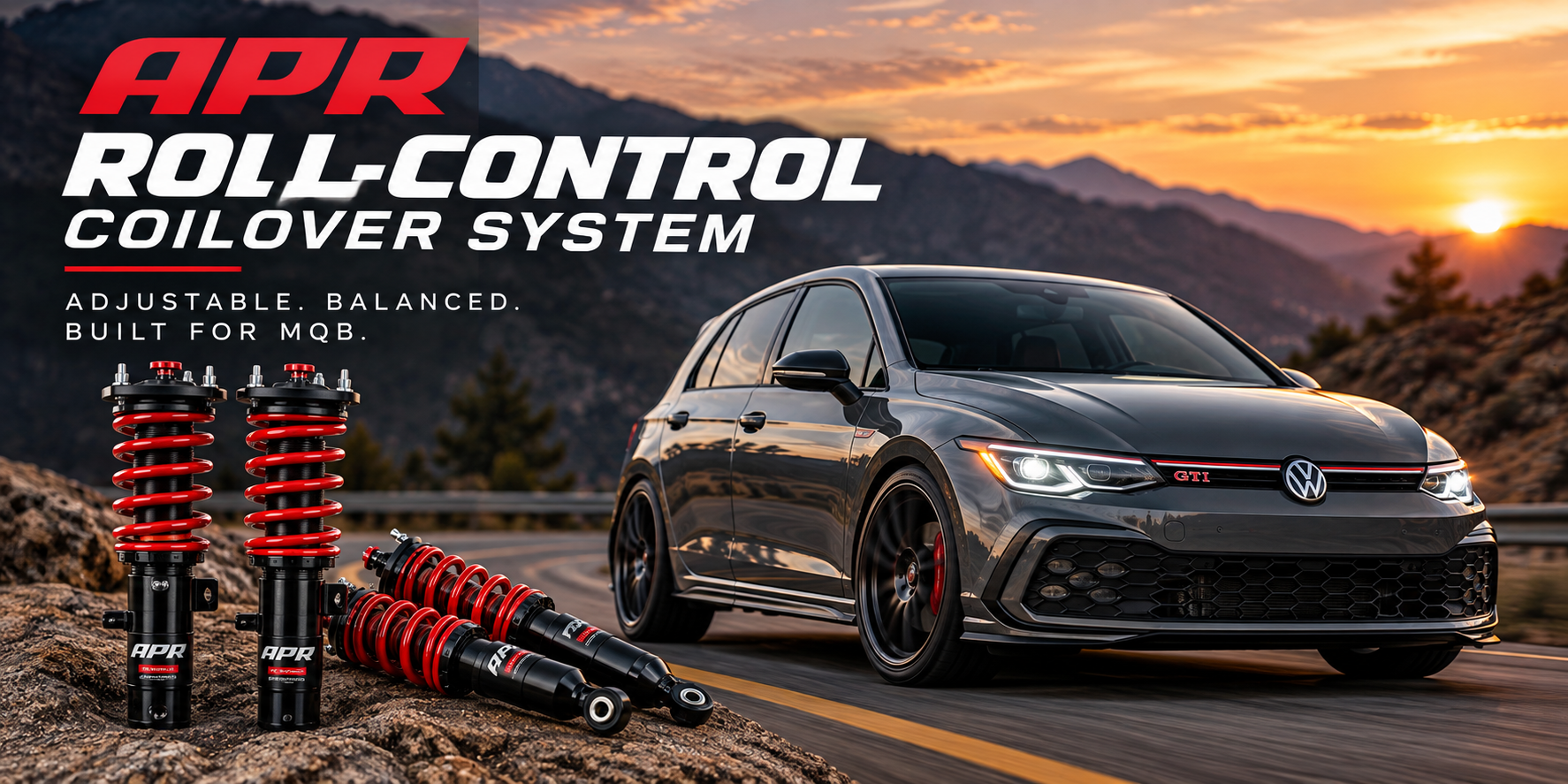
Horsepower gets attention, but suspension determines how effectively a performance car uses the road underneath it.
That is especially true on Volkswagen and Audi MQB-platform cars like the GTI, Golf R, A3, and S3. These vehicles already combine compact dimensions, strong turbocharged engines, and capable chassis, which makes suspension tuning one of the most meaningful ways to change how the car feels.
The APR Roll-Control Coilover System takes that idea much further than simply lowering the vehicle.
The system combines adjustable ride height, independent spring preload adjustment, 32-position damping control, and adjustable front camber plates into one package. That gives an owner considerably more control over how the car sits and responds than a basic lowering spring setup.
But more adjustment only helps if you understand what those adjustments actually do.
What Is the APR Roll-Control Coilover System?
The APR Roll-Control system is a complete front-and-rear coilover package designed for a broad range of Volkswagen and Audi MQB and MQB EVO applications.
Instead of replacing only the factory springs, the system replaces the dampers and springs together so ride height and suspension behavior can be adjusted as a complete package.
APR builds the system around monotube dampers, linear-rate springs, threaded shock bodies, adjustable damping, and front camber plates.
Drivers looking at the rest of the brand's chassis components can browse the full APR suspension collection at Elite Performance.
32-Way Damping Adjustment
Both the front and rear dampers provide 32 positions of damping adjustment from softer to firmer settings.
This does not mean there are 32 completely different suspensions hiding inside the same car. The adjustment changes how aggressively the damper controls suspension movement.
Softer settings generally allow the suspension to move more freely over road imperfections. Firmer settings provide more resistance to suspension movement, which can help control body motion during aggressive driving.
The useful part is being able to tune that balance instead of being locked into one fixed damper setting.
Independent Ride Height and Preload Adjustment
APR uses fully threaded shock bodies that allow ride height and spring preload to be adjusted independently.
That distinction matters.
On some coilover designs, lowering the vehicle can also alter spring preload or available shock travel. With independent adjustment, ride height can be changed without automatically making the same change to spring preload.
This gives the installer more control over the final suspension setup rather than treating ride height as the only variable.
Adjustable Front Camber Plates
The front struts include adjustable camber plates.
This gives the driver a way to add or reduce front negative camber beyond what the factory suspension normally allows.
Camber adjustment can be particularly valuable for performance driving because front tire alignment changes significantly as the car corners under load.
What Does a Coilover Actually Change?
A coilover can change several aspects of the vehicle at the same time.
That is why it should not be thought of simply as a way to remove wheel gap.
Ride Height
The most obvious change is vehicle height.
Lowering the chassis reduces the distance between the body and the ground and changes the visual relationship between the tires and wheel arches.
A moderate reduction in ride height can also lower the vehicle's center of gravity.
However, lower is not automatically better.
Excessive lowering can reduce suspension travel, create tire clearance problems, alter alignment, make the vehicle more vulnerable to road damage, and reduce everyday usability.
Body Control
Dampers influence how quickly the suspension moves when the vehicle brakes, accelerates, corners, or encounters a bump.
A better-controlled suspension can reduce unnecessary body movement and make the vehicle feel more deliberate during quick transitions.
That does not mean the firmest setting will produce the best handling. A suspension that is too stiff can lose contact with rough pavement instead of following it.
Alignment
Changing ride height changes suspension geometry.
Adding adjustable camber plates gives the installer another tool for correcting or intentionally tuning the front alignment after the vehicle is lowered.
Alignment should therefore be treated as part of the installation rather than an optional step afterward.
Why Does Damping Adjustment Matter?
Springs support the vehicle and determine how much force is required to compress the suspension. Dampers control the speed of that movement.
The two have to work together.
Softer Is Not Automatically Comfortable
A very soft damper setting can allow too much uncontrolled movement.
The car may float, oscillate after bumps, or take longer to settle after a quick steering input.
That can feel less composed even if the suspension initially seems softer.
Firmer Is Not Automatically Faster
Turning the dampers to their stiffest setting does not automatically create the fastest setup.
If the suspension cannot move enough to follow an uneven road surface, the tire may lose grip.
A track with smooth pavement can tolerate a different suspension setup than a rough back road.
Adjustment Lets You Find the Balance
The benefit of 32 damping positions is not that every driver needs to use all 32.
The benefit is having enough range to find a setting that works for the specific car, tire, road surface, and driving style.
Start from the manufacturer's recommended baseline and make small changes rather than jumping randomly between extremes.
How Should You Set Up Coilovers for Street Driving?
A street car has very different requirements from a dedicated track car.
It needs to deal with potholes, expansion joints, driveways, uneven pavement, passengers, luggage, rain, and thousands of miles of normal driving.
Keep the Ride Height Practical
A daily-driven GTI or A3 does not need to sit millimeters from the pavement to benefit from coilovers.
A moderate drop can improve stance while preserving useful suspension travel and ground clearance.
Think about the roads you actually drive before deciding how low the car should sit.
Start With Moderate Damping
A street setup typically benefits from enough damping to control body motion without making every road imperfection noticeable inside the cabin.
The adjustability of the APR system allows the owner to start relatively conservative and increase firmness if additional control is desired.
Use Sensible Camber
Large amounts of negative camber may look aggressive and can be useful in certain competition environments, but a daily-driven vehicle has different priorities.
Excessive camber can affect tire wear and reduce how much tire is contacting the road during normal straight-line driving.
Street alignment should balance handling with tire life and everyday stability.
How Should You Set Up Coilovers for Track Driving?
Track use changes suspension priorities because the car spends much more time near its cornering, braking, and acceleration limits.
Control Weight Transfer
During braking, weight moves toward the front axle. During acceleration, it moves rearward. During cornering, load transfers toward the outside tires.
Spring and damper settings influence how quickly those movements occur and how controlled the chassis feels during transitions.
Use Camber to Support the Tire
Performance tires generate their best grip when the contact patch remains properly positioned against the pavement.
As a vehicle corners, suspension movement and body roll can reduce the effectiveness of the outside front tire.
Additional negative camber can help keep more of that tire working during aggressive cornering.
The ideal amount depends on the vehicle, tire, track, suspension geometry, and driver.
Corner Balance the Car
Adjustable coilovers also create the opportunity to corner balance the vehicle.
Corner balancing measures how much weight is supported at each wheel and allows ride-height adjustments to improve the chassis balance.
This becomes much more relevant on a track-focused build than on a car lowered primarily for appearance.
Which Cars Can Use the APR Roll-Control System?
The APR Roll-Control system covers a wide range of Volkswagen and Audi applications built around related MQB-platform suspension architecture.
Current Elite Performance fitment includes applications across vehicles such as:
- Volkswagen GTI
- Volkswagen Golf R
- Volkswagen Jetta and Jetta GLI
- Volkswagen Golf
- Volkswagen Golf Alltrack
- Volkswagen Golf SportWagen
- Volkswagen Arteon
- Volkswagen Tiguan
- Volkswagen Taos
- Audi A3
- Audi S3
- Audi RS3
- Audi TT
- Audi TTS
- Audi TT RS
- Audi Q3
Exact fitment varies by model year, trim, suspension configuration, and drivetrain.
For example, GTI owners can browse the broader Volkswagen GTI parts catalog to compare suspension upgrades with the rest of the vehicle's build plan.
Independent Rear Suspension Is Required
APR specifies this coilover system for compatible vehicles using independent rear suspension.
That matters on platforms where different trims or markets may use different rear suspension configurations.
Never assume compatibility solely because two vehicles share a similar platform name.
DCC and Magnetic Ride Need Additional Attention
Vehicles equipped with electronically controlled factory dampers such as DCC or Magnetic Ride require additional consideration.
APR notes that sensor plugs are required to prevent suspension fault codes when the factory electronic dampers are removed. Those plugs are not included with the coilover kit.
Confirm the complete parts requirement before beginning installation.
How Does the APR System Compare With Lowering Springs?
Lowering springs and coilovers can both reduce ride height, but they are very different types of suspension modifications.
Lowering Springs
Lowering springs are usually the simpler option.
They replace the factory springs while retaining compatible factory or aftermarket dampers.
For someone who wants a fixed reduction in ride height and does not need substantial adjustability, springs can make sense.
APR itself offers Roll-Control lowering springs and other suspension components for several Volkswagen applications.
Coilovers
Coilovers replace more of the suspension system and provide much greater control over the final setup.
With the APR Roll-Control system, that includes:
- Front and rear ride-height adjustment
- Independent spring preload adjustment
- 32-position front and rear damping adjustment
- Front camber adjustment
That extra adjustability is valuable for enthusiasts who want to tune the suspension rather than simply lower the car.
What Else Should You Upgrade With Coilovers?
A suspension works as a system, so coilovers should be considered alongside tires, alignment, sway bars, bushings, brakes, and other chassis components.
Tires
The suspension cannot create grip the tire does not have.
A well-tuned coilover system paired with poor or inappropriate tires will still be limited by the available contact patch.
For a serious handling build, tire selection should be part of the plan from the beginning.
Sway Bars
Sway bars influence the relationship between the left and right suspension during cornering.
Changing sway-bar stiffness can alter the vehicle's balance and how readily the chassis rotates through a corner.
APR offers front and rear Roll-Control sway bars for several MQB applications, making them a natural supporting modification for drivers who want to continue tuning the chassis.
End Links
Lowering a vehicle can change sway-bar geometry.
Adjustable or upgraded end links can help optimize the bar's position and eliminate unwanted preload in certain setups.
Alignment
An alignment is essential after significant suspension work.
Ride height, toe, and camber all influence tire wear and handling.
Do not spend money on adjustable suspension and then skip the step that determines where the tires actually point.
Drivers planning a more complete chassis build can browse suspension parts at Elite Performance before deciding which upgrades should be installed together.
What Should You Know Before Installing Coilovers?
A coilover installation is more involved than replacing an intake or bolt-on engine-bay accessory.
Measure Before You Start
Record the factory ride height at each corner before disassembly.
This gives you a useful reference when deciding how much to lower the vehicle and makes it easier to compare the final setup.
Do Not Slam the Car Immediately
Start with a practical height.
You can always lower the vehicle further once you have confirmed tire clearance, suspension travel, driveway clearance, and daily usability.
Starting at the absolute minimum height makes troubleshooting much harder.
Torque Everything Correctly
Suspension fasteners are safety-critical.
Use the correct torque specifications and installation procedures for the vehicle and the coilover system.
If you do not have the equipment or experience required for suspension installation, professional installation is the safer option.
Get an Alignment
Once the final ride height has been established, the vehicle needs a proper alignment.
If you later make a substantial height or camber change, the alignment should be checked again.
Street, Track, or Show: What Are You Building?
The biggest advantage of an adjustable coilover system is that different owners can use the same hardware for very different goals.
Street Build
Keep the ride height practical, use moderate damping, and choose an alignment that protects tire life while sharpening the chassis.
Track Build
Use the available damping, camber, ride-height, and corner-balance adjustments to support the tire and improve chassis control under sustained aggressive driving.
Show-Oriented Build
The height adjustment allows a more aggressive stance for visual purposes, but extreme lowering and aggressive camber can introduce compromises in tire wear, suspension travel, ground clearance, and handling.
If appearance is the priority, understand those tradeoffs before setting the car up around stance alone.
Dual-Purpose Build
This may be where adjustable coilovers make the most sense.
A street-and-track car can use a reasonable everyday ride height and damping setup, then make measured changes for a track event without replacing the suspension again.
Is the APR Roll-Control Coilover System Worth Considering?
If your only goal is to close wheel gap slightly, a quality lowering spring may be all the suspension modification you need.
The APR system becomes more interesting when you want control over the setup itself.
Its combination of independent ride-height and preload adjustment, 32-position damping control, adjustable front camber, monotube dampers, and platform-specific hardware gives MQB enthusiasts significantly more room to tune the chassis.
That makes it suitable for someone who wants the same car to serve as a daily driver, weekend canyon car, autocross vehicle, or occasional track car.
The important part is actually using the adjustment intelligently.
A coilover system gives you tools. It does not automatically choose the right settings for you.
Build the Suspension Around the Way You Drive
A performance suspension should solve a problem.
Maybe you want less body movement. Maybe you need more front camber for track tires. Maybe you want to reduce ride height without sacrificing the ability to tune preload and damping. Or maybe you want one setup that can work on the street during the week and at the track on Saturday.
The APR Roll-Control system gives you the adjustment range to build around those goals instead of accepting one fixed suspension setup.
If that level of control fits your build, you can view the APR Roll-Control Coilover System at Elite Performance.
You can also browse APR performance parts to build the suspension alongside the rest of your Volkswagen or Audi setup.