Brembo GT Big Brake Kit for A90 Supra: What 6-Piston 380mm Brakes Actually Change
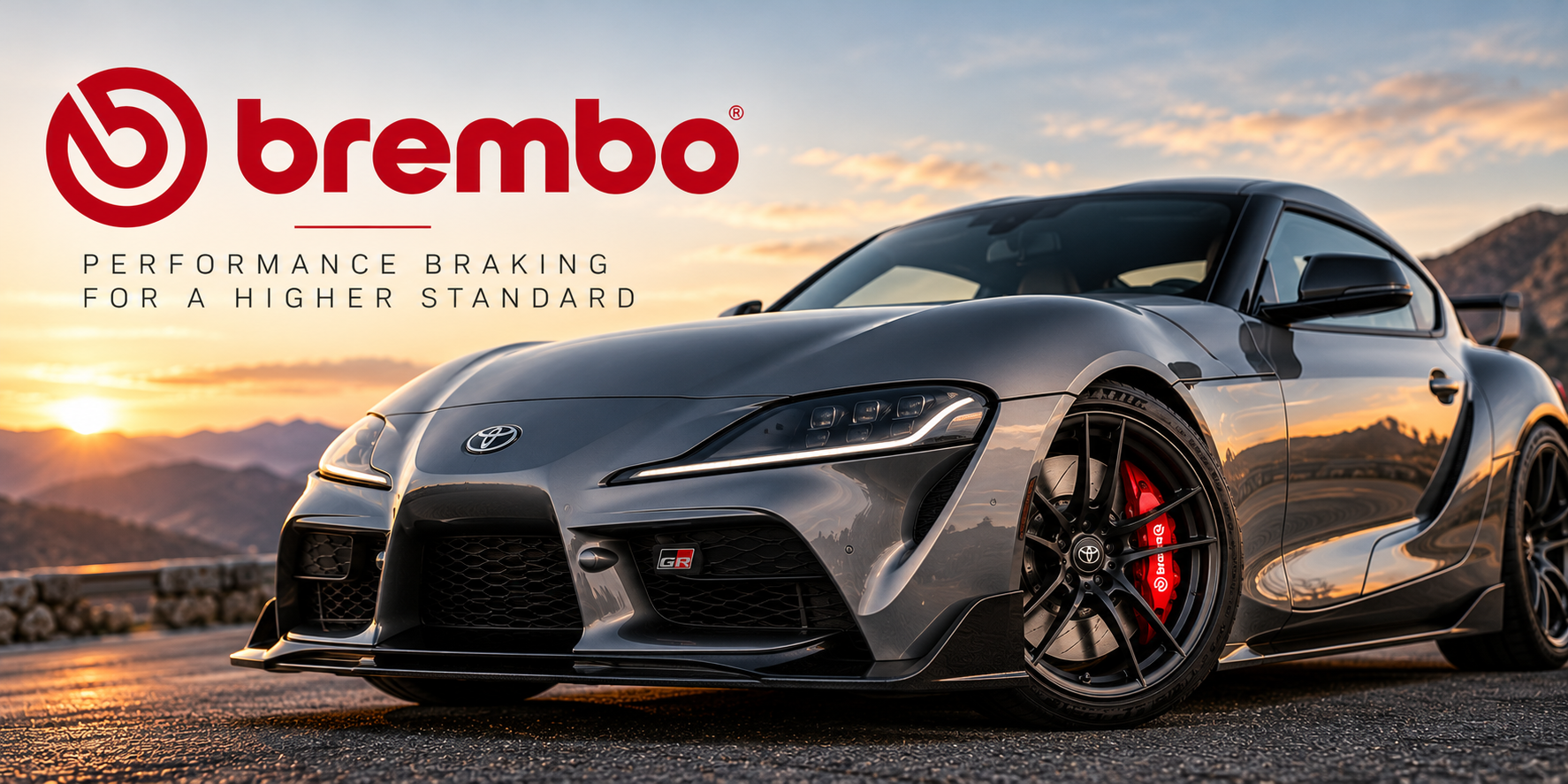
The Brembo GT front big-brake kit upgrades the A90/A91 Toyota GR Supra with six-piston calipers and massive 380x34mm two-piece rotors. Here’s what a big-brake kit really changes, why heat capacity matters more than simply adding piston count, how wheel clearance becomes critical, and when a street or track Supra actually benefits from the upgrade.
A big-brake kit is one of the easiest performance modifications to misunderstand.
Six-piston calipers look impressive. A 380mm rotor fills the wheel. And a large red Brembo caliper immediately makes the car look much more serious.
But the real reason to install a big-brake kit has much less to do with appearance.
The biggest advantage is usually thermal capacity and consistency.
That distinction matters on a car like the Toyota GR Supra.
A stock Supra can already generate enough braking force to activate ABS in a hard stop. Installing larger brakes does not magically allow the tires to create more grip.
Where a serious brake system begins to earn its keep is when the car is asked to repeat those hard stops again and again.
The Brembo GT Front Big Brake Kit for the 2020–2025 Toyota GR Supra replaces the front braking hardware with six-piston Brembo calipers and massive 380x34mm two-piece slotted rotors.
For a street Supra that never sees sustained aggressive braking, that may be more brake than the car needs.
For a modified Supra seeing canyon runs, autocross, time attack, road courses, or repeated high-speed braking, the argument becomes very different.
What Is the Brembo GT Big Brake Kit for the GR Supra?
The featured Brembo system is a front-axle GT-series brake kit designed for the A90/A91 Toyota GR Supra and related BMW Z4 applications.
The red version currently listed by Elite Performance uses:
- Six-piston Brembo front calipers
- 380x34mm two-piece rotors
- Type 3 slotted rotor faces
- Vehicle-specific mounting hardware
- A complete application designed around the Supra front axle
The exact red Brembo GT kit is currently listed by Elite Performance for 2020–2025 GR Supra applications including Base, Premium, A91, A91-MT, Launch Edition, and 45th Anniversary Edition configurations.
There Are Multiple Brembo Versions
Brembo does not offer only one version of the system.
Elite Performance also carries a black six-piston GT kit with 380x34mm Type 1 slotted rotors.
For an even more serious build, there is also the Brembo GT-R six-piston billet 380x34mm system.
Those kits share the same general goal but are not identical products.
What Does a Big-Brake Kit Actually Improve?
The first thing to understand is what it does not automatically improve.
If your Supra can already lock the tires hard enough for ABS to intervene, the factory brakes are already capable of producing more braking torque than the tires can use during that particular stop.
A larger caliper and rotor cannot override the traction limit of the tire.
What the larger system can do is maintain braking performance more consistently as temperature rises.
More Thermal Capacity
Every time you slow the car, kinetic energy is converted into heat.
During one hard highway stop, the system may absorb that heat without difficulty.
On a road course, the brakes may need to repeat that process dozens of times during one session.
A larger rotor provides more material and surface area to absorb, distribute, and reject heat.
Reduced Brake Fade
As brakes become excessively hot, several things can begin to change.
The pad compound may move outside its preferred temperature range.
Brake fluid can become overheated.
Pedal feel may change.
Stopping performance can become progressively less consistent.
A properly matched big-brake system increases the amount of thermal energy the front brakes can manage before those problems become the limiting factor.
Greater Repeatability
This is the real performance advantage.
The question is not simply:
Can the car stop hard once?
The question becomes:
Can it stop hard at the end of every straight for an entire session?
Why Use a Six-Piston Caliper?
Piston count gets a lot of attention because it is easy to advertise.
More pistons, however, do not automatically mean a better brake system.
The benefit comes from how the complete caliper is engineered.
Pressure Distribution Across a Large Pad
Multiple pistons allow the caliper to distribute force across a large brake pad.
That becomes useful as pad surface area grows and the brake system is expected to operate under repeated high thermal loads.
Caliper Rigidity
A performance caliper also needs to resist flex.
When hydraulic pressure rises, the caliper body experiences significant force.
If the caliper deflects excessively, some pedal movement is spent deforming hardware rather than applying the pad to the rotor.
A rigid fixed caliper can therefore contribute to a more consistent pedal response.
Piston Size Matters More Than Piston Count Alone
Brake torque and pedal behavior depend on total piston area, rotor diameter, pad friction, master-cylinder characteristics, and many other factors.
Simply replacing a four-piston caliper with any random six-piston caliper would not necessarily improve the car.
This is why a vehicle-specific engineered kit matters.
Why Are the Rotors 380x34mm?
The featured Brembo GT kit uses a rotor measuring 380mm in diameter and 34mm thick.
Both dimensions matter.
Rotor Diameter
A larger diameter moves the friction surface farther away from the hub center.
That gives the brake system additional mechanical leverage for a given pad force.
Rotor Thickness
A 34mm-thick vented rotor provides substantial internal volume for absorbing and managing heat.
Thickness is especially important in a car expected to see repeated high-energy braking events.
Larger Is Not Automatically Better Forever
A rotor cannot simply grow infinitely.
Increasing size also affects:
- Weight
- Wheel clearance
- Rotational inertia
- Unsprung mass
- Brake balance
- Cost
The goal is enough brake capacity for the vehicle's use—not the largest rotor physically capable of fitting behind a wheel.
Why Use a Two-Piece Rotor?
The Brembo GT system uses a two-piece rotor rather than one solid piece of iron from the hub area to the friction surface.
That allows the rotor hat and friction ring to perform different jobs.
Iron Friction Ring
The outer disc needs the thermal and friction characteristics required for the brake pad interface.
Separate Hat
The center hat can be manufactured differently because it does not need to act as the friction surface.
This arrangement can help manage mass and thermal expansion while allowing the disc ring to be replaced separately on serviceable performance applications.
Heat Expansion Matters
A rotor grows as it becomes hot.
Performance two-piece designs are engineered to accommodate that thermal behavior more effectively than treating the entire assembly as one uniform chunk of material.
What Do Slotted Rotors Do?
The featured red Supra kit uses Brembo's Type 3 slotted rotor design.
The black alternative linked above uses a Type 1 slotted configuration.
Slots can help keep the pad interface consistent under aggressive use.
Cleaning the Pad Surface
The slot passes across the pad as the rotor turns.
This can help remove material from the pad surface and maintain a fresh friction interface.
Gas and Debris Management
The channels also provide a path for some gases and debris generated at the friction interface.
The Tradeoff
An aggressive slotted rotor can increase pad wear compared with a completely plain rotor.
That tradeoff may be worthwhile on a car where consistent high-temperature braking matters more than maximizing pad life.
Will a Brembo Big-Brake Kit Shorten Stopping Distance?
It can under some circumstances, but this is not the reason to assume every Supra needs one.
During a single emergency stop from moderate speed, the limiting factor may be the tires rather than the brake hardware.
Tires Create the Final Braking Force
The brake system slows the wheel.
The tire transfers that force to the pavement.
If the tire has reached its available grip, adding more brake torque does not create more road traction.
Where Bigger Brakes Can Win
The difference becomes more obvious after repeated high-speed stops.
If the factory system becomes too hot and begins fading while the Brembo system remains within its operating range, the larger system can maintain stopping performance that the overheated system no longer can.
Tires Still Matter
A Supra receiving a $4,000–$10,000 brake system should also be running tires appropriate for the level of performance expected from the car.
Brakes and tires work as one system.
What About Brake Bias?
Brake bias describes how braking work is distributed between the front and rear axles.
The front brakes normally do more work because weight transfers toward the front axle during deceleration.
Why a Vehicle-Specific Kit Matters
Changing rotor diameter and caliper piston area changes the braking characteristics of the axle.
A properly developed Brembo application is engineered around the vehicle instead of asking the installer to assemble unrelated calipers and rotors.
ABS and Stability Control Are Still Part of the Car
The modern Supra uses sophisticated electronic brake and stability systems.
The mechanical brake hardware still has to work predictably within the overall vehicle system.
This is another reason not to treat a brake upgrade as a collection of individually impressive parts.
GT vs. GT-R Brembo Kits: What's the Difference?
Elite Performance currently carries both GT and GT-R front brake systems for the Supra.
Brembo GT
The red Brembo GT kit uses a six-piston cast caliper with 380x34mm two-piece rotors.
This is already an extremely substantial upgrade for a road-and-track Supra.
Brembo GT-R
The GT-R version moves into Brembo's more specialized territory with a six-piston billet caliper.
Elite currently lists that kit at nearly twice the price of the GT system.
Which One Makes Sense?
For most modified street cars and occasional track cars, the GT system already represents a serious level of hardware.
The GT-R system makes more sense when the build itself has moved toward a much more dedicated motorsport use case and the additional expense can be justified.
Buying the most expensive caliper available does not make the car faster if the rest of the build cannot take advantage of it.
Will the Brembo Kit Fit Behind Your Wheels?
This is one of the most important questions in the entire article.
A 380mm rotor and six-piston caliper require substantial wheel clearance.
Wheel diameter alone is not enough to determine fitment.
Radial Clearance
The inside of the wheel barrel needs enough space around the outside diameter of the caliper and rotor.
Spoke Clearance
The caliper also projects outward toward the backside of the wheel spokes.
A wheel can have enough barrel diameter and still fail to clear the caliper face.
Offset Does Not Tell the Whole Story
Two wheels with the same width and offset can have completely different spoke curvature.
One may clear the Brembo caliper easily while the other contacts it.
Use a Brake Template
When available, a manufacturer brake-clearance template is far more useful than guessing from wheel diameter.
Print it at the correct scale and compare it physically against the wheel before mounting tires.
Should You Use Wheel Spacers for Caliper Clearance?
A spacer can sometimes create additional spoke-to-caliper clearance by moving the wheel outward.
But it should not be treated as an automatic solution.
Outer Fender Clearance Changes
Move the wheel outward and the tire also moves closer to the fender.
Stud or Bolt Engagement Matters
Wheel hardware still needs sufficient engagement.
The Better Solution May Be the Correct Wheel
If a wheel fundamentally does not work with the brake package, choosing a wheel designed with appropriate big-brake clearance may create a cleaner overall setup than trying to correct everything with spacers.
Does a Bigger Brake Kit Add Unsprung Weight?
Potentially.
Larger rotors contain more material, and six-piston calipers are substantial components.
Two-piece rotor construction can help manage weight, but increased brake capacity still involves a physical tradeoff.
Why the Tradeoff Can Be Worth It
For a track-driven Supra, increased thermal capacity may be much more valuable than chasing the lowest possible brake-system weight.
The correct balance depends on the build.
Street Cars Should Be Realistic
If the Supra never experiences brake fade and never sees repeated hard braking, adding huge brakes solely because they look impressive behind the wheels may not improve the driving experience enough to justify the cost.
What Brake Pads Should You Use?
The caliper is only one part of the friction system.
Brake-pad compound determines a huge amount of how the system behaves.
Street Pad
A road-oriented compound may prioritize:
- Cold bite
- Low noise
- Low dust
- Rotor life
- Predictable everyday behavior
Track Pad
A competition compound may prioritize:
- High-temperature friction
- Fade resistance
- Consistency over repeated stops
The tradeoff can be substantially more noise, dust, and rotor wear.
One Pad Does Not Have to Do Everything
For a Supra used heavily on both road and track, maintaining separate street and track pad compounds can make more sense than expecting one pad to excel everywhere.
You can compare Brembo replacement pads, rotors, and related components through the Brembo Brakes, Rotors & Pads collection at Elite Performance.
Why Does Brake Fluid Matter?
The fluid transfers force from the master cylinder to the caliper pistons.
It also lives extremely close to components generating enormous heat.
Brake Fluid Absorbs Moisture
Most conventional performance brake fluids are hygroscopic, meaning they gradually absorb moisture from the environment.
As moisture content rises, boiling performance deteriorates.
Track Use Raises Temperatures Dramatically
If brake fluid reaches its boiling point, vapor can form in the hydraulic system.
Unlike liquid, vapor compresses easily.
The result can be an alarming soft or sinking pedal.
Fresh Fluid Is Part of a Track Brake System
Installing a large Brembo kit while ignoring old brake fluid defeats part of the reason for upgrading the hardware.
Brake fluid, pads, cooling, tires, and driver technique all contribute to how well the system performs.
Do You Need Brake Cooling?
For normal street use, probably not.
For serious repeated track use, ducting can become valuable even with large brakes.
More Brake Capacity Does Not Eliminate Heat
The system still has to reject the energy absorbed during braking.
A large rotor increases capacity, but airflow helps carry that heat away.
Track Layout Matters
A high-speed circuit with repeated heavy braking zones may be much harder on the system than a flowing circuit with fewer major stops.
Brake cooling should therefore be considered around actual track use rather than installed simply because the car has a big-brake kit.
How Important Is Proper Bedding?
Extremely important.
New pads and rotors need to establish a consistent friction interface.
Pad Transfer Layer
Proper bedding helps establish a uniform layer of pad material on the rotor surface.
An inconsistent transfer layer can create vibration that drivers sometimes mistake for a physically warped rotor.
Follow the Pad and Brake Manufacturer's Procedure
Do not invent a bedding process from a random internet post.
The correct heat cycle depends on the friction material and braking hardware being used.
Is a Brembo GT Kit Good for a Daily Driver?
Yes, provided the brake-pad compound and wheel package are appropriate.
A high-quality big-brake kit does not automatically make the car miserable on the street.
What You May Notice
Depending on the pad compound, you may experience:
- Different pedal response
- More brake dust
- Different cold-bite characteristics
- More audible pad noise
The Caliper Is Not Usually the Problem
Many of the compromises people associate with “race brakes” actually come from aggressive competition pads rather than the fact that the caliper has six pistons.
A street-focused friction material can make a serious Brembo system much easier to live with every day.
Who Actually Needs This Upgrade?
The Brembo GT kit makes the strongest case for a Supra that regularly generates more brake heat than the stock system comfortably manages.
Good Candidates
- Road-course cars
- Time-attack builds
- High-speed canyon or mountain cars
- Heavily modified Supras making substantially more power
- Cars running significantly stickier tires
- Drivers experiencing repeated brake fade
Probably Overkill If...
- The car is almost entirely street driven
- You have never experienced brake fade
- The factory brakes already meet your needs
- You still have poor tires or worn suspension components
- The upgrade is being considered only for caliper appearance
There is nothing wrong with buying a Brembo kit partly because it looks incredible.
Just understand where the actual performance benefits come from.
What Should You Check Before Ordering?
Before ordering the Brembo GT system, confirm:
- Exact Supra model year and trim
- Front wheel diameter
- Wheel width
- Wheel offset
- Caliper-to-spoke clearance
- Barrel clearance
- Current tire performance level
- Street vs. track use
- Desired brake-pad compound
- Condition of brake fluid
- Whether replacement track wheels also need to clear the kit
Check Both Sets of Wheels
If you use one wheel set on the street and another at the track, both need to clear the Brembo system.
Discovering that your street wheels fit while your dedicated track wheels do not is an expensive mistake.
Is the Brembo GT Big Brake Kit Worth It?
For the right Supra, absolutely.
The Brembo six-piston 380x34mm GT front kit gives the car substantially more front brake hardware and, more importantly, significantly greater ability to manage repeated high-energy braking.
That is the reason to buy it.
Not because six pistons automatically stop a car shorter.
Not because 380mm is automatically better than every smaller rotor.
And not because a huge red caliper makes the horsepower number go up.
The upgrade becomes valuable when the braking system needs to perform consistently at temperatures and duty cycles beyond what the standard hardware was designed to handle comfortably.
Build the Supra's Brakes Around How You Drive
A street Supra, canyon car, drag car, and road-course car all ask different things from the braking system.
If your build has reached the point where repeatable high-temperature braking matters, start with the red Brembo GT six-piston front kit.
If you want a darker appearance with similar GT-series architecture, compare the black 380x34mm Brembo GT system.
For a much more specialized build, look at the Brembo GT-R billet six-piston kit.
You can also browse all Brembo performance parts at Elite Performance, compare the complete Brembo Brakes, Rotors & Pads collection, or explore the broader Brakes, Rotors & Pads category.
For the rest of the build, browse the Toyota GR Supra parts catalog at Elite Performance.