Eibach PRO-KIT for S650 Mustang: Lowering Without Giving Up MagneRide
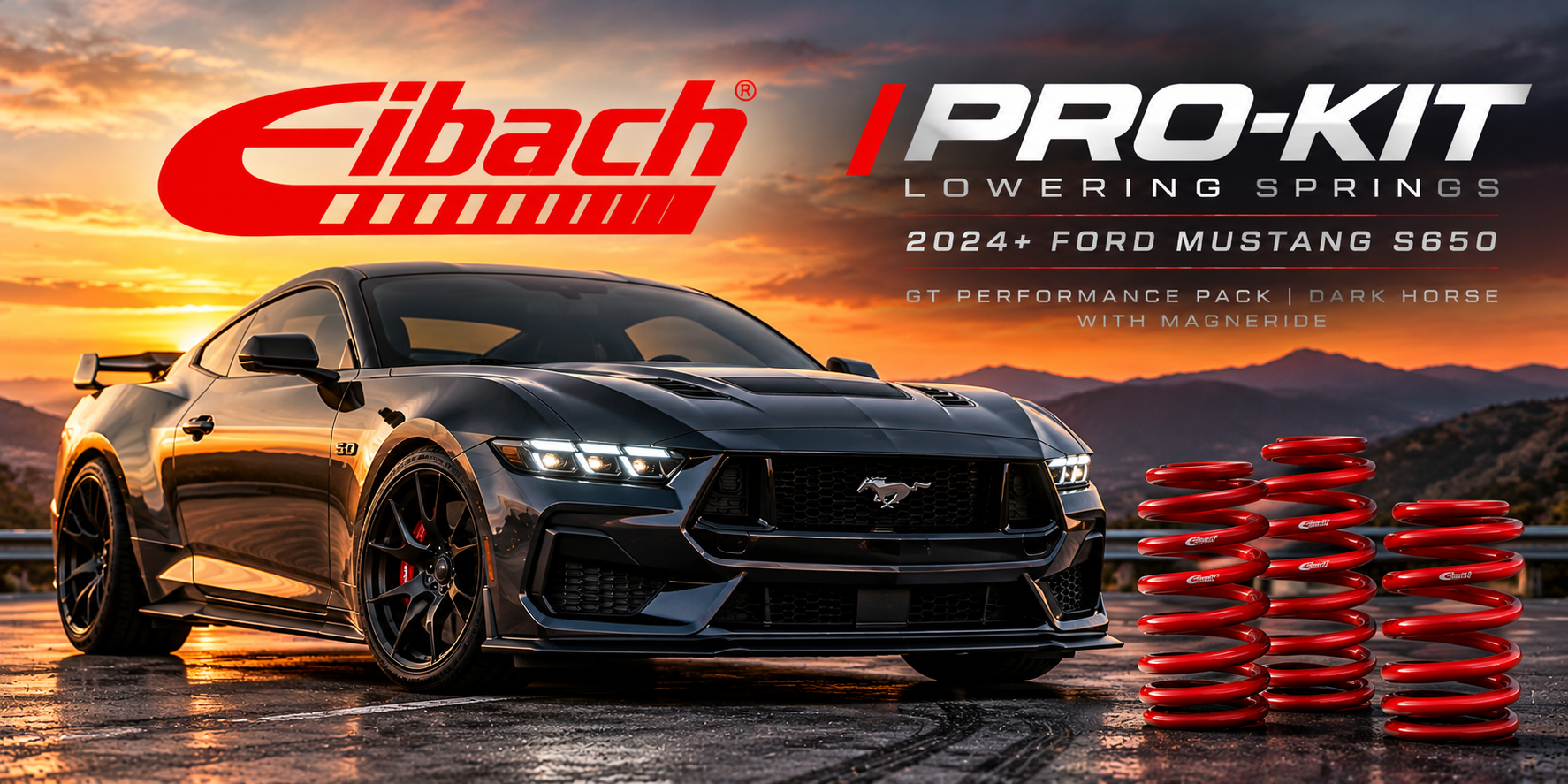
The Eibach PRO-KIT lowers the 2024+ Mustang GT Performance Pack and Dark Horse while retaining the factory MagneRide dampers. Here’s how the progressive springs change ride height, stance, handling, alignment, wheel fitment, and everyday drivability.
The S650 Mustang already sits on one of the most capable factory chassis Ford has put underneath a Mustang.
But even a Mustang GT Performance Pack or Dark Horse leaves the factory with enough ride height and fender gap to remind you that Ford still has to design the car around driveways, production tolerances, passengers, cargo, rough roads, and buyers who may never modify the suspension.
For an enthusiast, that leaves room for improvement.
The Eibach PRO-KIT for the S650 Mustang GT Performance Pack with MagneRide and Dark Horse is designed to lower the car while retaining the factory electronic dampers.
That distinction matters.
Instead of replacing Ford's MagneRide system with conventional coilovers or fixed dampers, the PRO-KIT changes the spring side of the suspension while allowing the factory adaptive damping system to remain part of the car.
For a Mustang that still needs to function as a daily driver, weekend car, or occasional track car, that can be a very appealing compromise.
What Is the Eibach PRO-KIT?
The Eibach PRO-KIT is a set of four performance lowering springs engineered for specific vehicle applications.
The S650 kit featured here is Eibach part number E10-35-064-02-22.
Eibach designed this particular spring set around compatible 2024–2026 S650 Mustang applications using the factory MagneRide suspension, including the Mustang GT Performance Pack and Dark Horse.
Progressive Spring Design
The PRO-KIT uses progressive-rate spring design rather than one fixed spring rate through the entire range of compression.
The idea is to preserve useful compliance during normal driving while providing additional control as suspension load increases.
That makes progressive springs particularly attractive for street cars that need to handle both ordinary road imperfections and aggressive cornering.
Designed for the Factory Dampers
Eibach specifically states that this kit is designed for use with the original-equipment shocks.
On the appropriate MagneRide Mustang, that means the electronically controlled factory dampers stay in the car.
The suspension becomes lower and mechanically different without throwing away one of the more sophisticated parts of the factory Performance Pack and Dark Horse chassis.
How Much Does the Eibach PRO-KIT Lower the S650 Mustang?
The amount of lowering depends on the exact Mustang application.
Mustang GT Performance Pack With MagneRide
For the 2024–2026 Mustang GT Coupe Performance Pack with MagneRide, Eibach specifies approximately:
- 1.6 inches lower in front
- 1.3 inches lower in rear
That is a substantial enough change to noticeably reduce the factory wheel gap and lower the visual mass of the car without moving into an extreme show-oriented ride height.
Mustang Dark Horse
For the S650 Dark Horse, Eibach specifies approximately:
- 1.0 inch lower in front
- 1.5 inches lower in rear
The different drop figures reflect the fact that the GT Performance Pack and Dark Horse do not begin from exactly the same suspension configuration and ride height.
This is a good example of why a lowering spring should be purchased by exact application rather than simply because another S650 owner used the same brand.
Why Lower the Center of Gravity?
Lowering a vehicle changes more than the amount of space between the tire and fender.
The body of the car sits closer to the ground, lowering the vehicle's center of gravity.
Reduced Body Movement
During cornering, braking, and acceleration, weight moves through the chassis.
Lowering the center of gravity can reduce some of the leverage creating body roll and pitch.
That can make the car feel more settled during quick transitions.
Sharper Response
A lower ride height combined with performance-oriented spring rates can make steering inputs feel more immediate because the body moves less before the chassis responds.
This is one of the reasons lowering springs can change the personality of a car even when the engine and tires remain untouched.
Lower Is Not Automatically Better
There is a limit.
Suspension needs travel to keep the tires in contact with imperfect pavement.
Lowering a car excessively can reduce usable travel and create a suspension that reaches the bump stops too easily.
The goal of a performance spring should be a usable chassis improvement, not simply placing the body as close to the pavement as possible.
Why Keep MagneRide?
Ford's MagneRide system is one of the strongest arguments for using a spring kit instead of immediately replacing the complete suspension.
MagneRide electronically adjusts damper behavior based on vehicle conditions and selected drive modes.
The Dampers Still Adapt
The Eibach springs change the mechanical spring characteristics and ride height, but the original adaptive dampers remain installed.
That allows the Mustang to retain the factory-controlled damping system.
You still have a suspension designed to change damper behavior rather than being locked into one fixed shock setting.
No Need to Delete an Expensive Factory System
A high-quality coilover system can provide substantially more adjustability, but moving away from MagneRide may require additional hardware or electronic solutions depending on the suspension chosen.
For an owner who already paid for a Mustang equipped with adaptive dampers and likes how they function, keeping them makes sense.
Good Match for a Dual-Purpose Street Car
A daily-driven Mustang has to handle potholes, expansion joints, highway cruising, passengers, and normal roads.
It may also spend weekends on mountain roads or occasionally visit a track.
Retaining adaptive dampers while changing the springs can provide a useful balance between those environments.
Does Lowering Change Ride Quality?
Yes. Any meaningful spring change can affect ride quality.
The important question is how.
Less Suspension Travel
When the car sits lower, there is less distance available before the suspension reaches the end of its compression travel.
That can make large road impacts more noticeable.
Spring Rate Changes
A performance spring generally needs additional control compared with a comfort-focused factory spring.
That does not automatically mean the car becomes harsh, especially with a progressive spring design, but you should expect the suspension to feel more purposeful.
Tires Matter Too
Ride quality is not determined only by the springs.
A lowered Mustang on 20-inch wheels and very low-profile tires may feel dramatically firmer than the same springs paired with an 18- or 19-inch setup using more sidewall.
Wheel-and-tire choices should be considered alongside the suspension.
How Does Lowering Affect Wheel Fitment?
Lowering and wheel fitment are directly connected.
A wheel-and-tire package that has generous clearance at stock ride height may have much less room after the body moves closer to the tire.
Outer Fender Clearance
If the wheels already sit aggressively toward the fenders, lowering the car can increase the chance of contact during suspension compression.
Tire width, wheel width, offset, camber, and actual tire dimensions all matter.
Inner Clearance
Outer clearance gets most of the attention, but the tire also needs adequate room around struts, control arms, liners, and other suspension components.
Changing wheel offset can solve one clearance problem while creating another.
Do Not Judge Fitment While Parked
A Mustang can look perfectly flush in a parking lot and still rub while turning or when the suspension compresses over a bump.
Fitment needs to work through the actual range of suspension movement.
If you're planning wheels at the same time, the clean 2024 Mustang suspension catalog at Elite Performance gives you a useful starting point for building the chassis as a complete system.
Will Lowering Change the Alignment?
Yes.
Changing ride height changes the resting position of the suspension arms and therefore changes alignment geometry.
Camber
As many independent suspension designs move through their travel, camber changes.
Lowering the Mustang can therefore create additional negative camber.
A moderate amount may benefit cornering, but excessive negative camber can contribute to uneven tire wear.
Toe
Toe is particularly important because even a relatively small amount of incorrect toe can wear tires quickly.
A car that looks aligned because the steering wheel is straight may still have poor toe settings after lowering.
Alignment Is Part of the Installation
Eibach's own installation documentation specifically calls for inspecting and adjusting wheel alignment after the springs are installed.
That should be treated as part of the job rather than an optional follow-up.
Do You Need Camber Plates or Adjustable Arms?
Not automatically.
Whether additional alignment hardware is required depends on the final alignment numbers and how the car will be used.
Street Car
A street-driven Mustang should generally prioritize predictable handling and reasonable tire wear.
If the factory adjustment range can produce an appropriate alignment after lowering, adding more hardware solely because the car is lowered may not be necessary.
Track Car
A car seeing repeated track use may benefit from additional front negative camber to keep the outside front tire working effectively during hard cornering.
That is a different goal from simply bringing a street car back into alignment.
Measure Before Buying Parts
Install the springs, allow the suspension to settle, measure the alignment, and then determine what adjustment range you actually need.
Buying every adjustable suspension component before knowing the alignment requirements can add expense and complexity without solving a real problem.
PRO-KIT or Coilovers?
Both can lower the Mustang, but they solve different problems.
Choose Lowering Springs If...
The Eibach PRO-KIT makes sense if you:
- Want a predetermined performance-oriented ride height
- Want to retain factory MagneRide
- Do not need independent ride-height adjustment
- Want fewer suspension variables to tune
- Use the car primarily on the street
- Want a lower-cost route than a full premium coilover system
Choose Coilovers If...
A coilover system may be more appropriate if you:
- Need adjustable ride height
- Want adjustable damping beyond the factory system
- Plan to corner-balance the car
- Need extensive track-specific setup control
- Are prepared to replace or integrate around the factory MagneRide system
There is no reason to install coilovers simply because they are more expensive or more adjustable.
Adjustability only has value if you actually need and understand how to use it.
PRO-KIT or Sportline Springs?
Eibach's PRO-KIT and Sportline products traditionally target different levels of lowering.
PRO-KIT
The PRO-KIT generally emphasizes a balance between lowering, handling, and road usability.
It is usually the more natural option for a car that remains a daily driver or frequently sees imperfect public roads.
Sportline
Sportline springs generally pursue a more aggressive drop and appearance.
A greater drop can further reduce wheel gap but also reduces available ground clearance and suspension travel.
The right choice depends on whether the primary goal is a balanced performance street setup or a more aggressive lowered stance.
What About Speed Bumps and Driveways?
This is where lowering becomes very real very quickly.
A 1.0- to 1.6-inch drop may not sound dramatic on paper, but the front splitter, underbody panels, exhaust, and other low points all move closer to the road.
Approach Angle Changes
Steep driveways become more likely to contact the front of the vehicle.
Approaching at an angle may become necessary in places where the stock car could drive straight in.
Parking Stops
Do not assume the front bumper or splitter will clear every parking block simply because it did at factory ride height.
Real Roads Should Influence the Setup
If the car spends most of its life on rough urban roads, an extreme drop may become irritating very quickly.
A street suspension should make you want to drive the car more, not make every parking garage an obstacle course.
Does Lowering Help Braking?
Lowering can reduce body pitch under braking, which may make the chassis feel more controlled.
However, springs alone do not magically create shorter braking distances.
Stopping performance still depends heavily on tires, brake hardware, temperature, road conditions, ABS calibration, and available traction.
Chassis Control vs. Absolute Grip
A more controlled body can make hard braking feel more stable.
But the tire contact patch ultimately determines how much braking force can be transferred to the pavement before the tires reach their traction limit.
Suspension and tires should be considered together.
Should You Add Sway Bars?
Lowering springs and sway bars affect the chassis in different ways.
Springs support individual corners of the vehicle and influence vertical suspension movement. Sway bars connect left and right suspension movement and influence body roll distribution during cornering.
Eibach Offers Matching Anti-Roll Hardware
Eibach also develops front and rear Anti-Roll-Kits for the S650 platform, including compatible GT Performance Pack and Dark Horse applications.
That makes sway bars a logical next step for someone who wants additional chassis tuning after installing the springs.
Do Not Change Everything at Once Unless You Have a Plan
If you change springs, sway bars, alignment, tires, and wheel dimensions simultaneously, it becomes harder to know which change created a handling characteristic you like—or dislike.
For many street builds, making one logical set of changes at a time makes the car easier to evaluate.
You can compare Eibach chassis components through the clean Eibach suspension collection at Elite Performance.
What About the Dark Horse?
The Dark Horse begins with a more performance-focused factory setup than a standard Mustang GT.
That does not mean there is no room to change the suspension.
Different Factory Starting Point
Eibach's own specifications demonstrate the difference clearly.
The Dark Horse uses a different front/rear lowering amount from the GT Performance Pack even though both use the same E10-35-064-02-22 spring kit.
This is why suspension results should always be evaluated based on the exact application rather than simply saying the springs “lower an S650 Mustang by X inches.”
Track Use Still Changes Priorities
A Dark Horse used primarily for track days may benefit from a very different alignment and chassis setup from one used mostly for weekend road driving.
The springs establish ride height and spring behavior, but tires, alignment, sway bars, and driver goals still determine the final setup.
What Should You Check Before Ordering?
Before ordering the Eibach PRO-KIT, confirm the exact vehicle rather than buying from the words “2024 Mustang” alone.
Check:
- Model year
- GT Performance Pack or Dark Horse configuration
- MagneRide equipment
- Current suspension modifications
- Wheel diameter and width
- Wheel offset
- Tire dimensions
- Current ride height
- Front splitter or aero equipment
- Desired final alignment
MagneRide Fitment Matters
This particular spring kit is engineered around compatible MagneRide-equipped applications.
Do not assume the same suspension part is appropriate for a non-MagneRide Mustang simply because the body and engine are otherwise similar.
Use the Exact Product Listing
The Eibach S650 Mustang PRO-KIT product page at Elite Performance should be your product-level reference before ordering.
What Should Happen After Installation?
Installation is not finished when the car comes off the lift.
Check Clearance
Eibach specifically recommends checking tire-to-fender clearance, especially when aftermarket wheels or tires are installed.
Turn the steering through its range and inspect clearance under suspension compression where possible.
Inspect Brake and ABS Hardware
Brake lines and ABS sensor wiring need to remain properly routed and clear of moving suspension components.
Get an Alignment
The vehicle should receive a proper alignment after the new ride height is established.
If the springs settle enough to meaningfully change ride height afterward, rechecking alignment is worthwhile.
Recheck the Car
After driving the car for a period of time, inspect accessible suspension hardware and look for unexpected contact or tire rubbing.
A clean installation should remain quiet and predictable.
Who Is the Eibach PRO-KIT Best For?
This spring kit makes the most sense for someone who wants the S650 to look and feel noticeably more purposeful without turning the suspension into a fully adjustable race setup.
It is particularly appealing for:
- Daily-driven Mustang GT Performance Pack builds
- Weekend Dark Horse builds
- Street cars that occasionally see track use
- Owners who want to retain MagneRide
- Cars receiving aftermarket wheels and tires
- Drivers who want less wheel gap without an extreme stance
If the goal is maximum ride-height adjustability, corner balancing, or a highly specialized competition chassis, a different suspension system may make more sense.
Is the Eibach PRO-KIT Worth Considering?
For a MagneRide-equipped S650 Mustang, the strongest argument for the PRO-KIT is that it changes the things many owners want changed without automatically discarding what Ford already did well.
The car sits lower.
The wheel gap is reduced.
The center of gravity moves down.
The springs provide a more performance-oriented chassis response.
And the factory adaptive dampers remain in the system.
That makes the Eibach PRO-KIT a compelling middle ground between leaving the suspension completely stock and replacing the entire system with coilovers.
Build the Suspension Around the Mustang You Actually Drive
A suspension upgrade should match how the car is used.
If the Mustang is a street car first, preserving ride quality, ground clearance, tire life, and factory MagneRide functionality matters.
If it is becoming a more dedicated track car, alignment range, sway-bar tuning, tire choice, and additional chassis adjustability become increasingly important.
The Eibach PRO-KIT gives you a strong foundation without forcing the build in either direction.
Start with the Eibach PRO-KIT for the S650 Mustang, compare other components in the Eibach suspension lineup, or browse the full 2024 Ford Mustang parts catalog to build the rest of the car around the suspension.