Garrett PowerMax Stage 1: A Direct-Fit Turbo Upgrade for MK7 GTI and Golf R
The Garrett PowerMax Stage 1 gives MK7 Volkswagen and Audi 2.0T owners a direct-fit path beyond the factory IS20 or IS38 turbo. Here’s how its 485-hp capability, GT2260S architecture, factory-style fitment, tuning needs, and supporting mods fit into a serious street build.
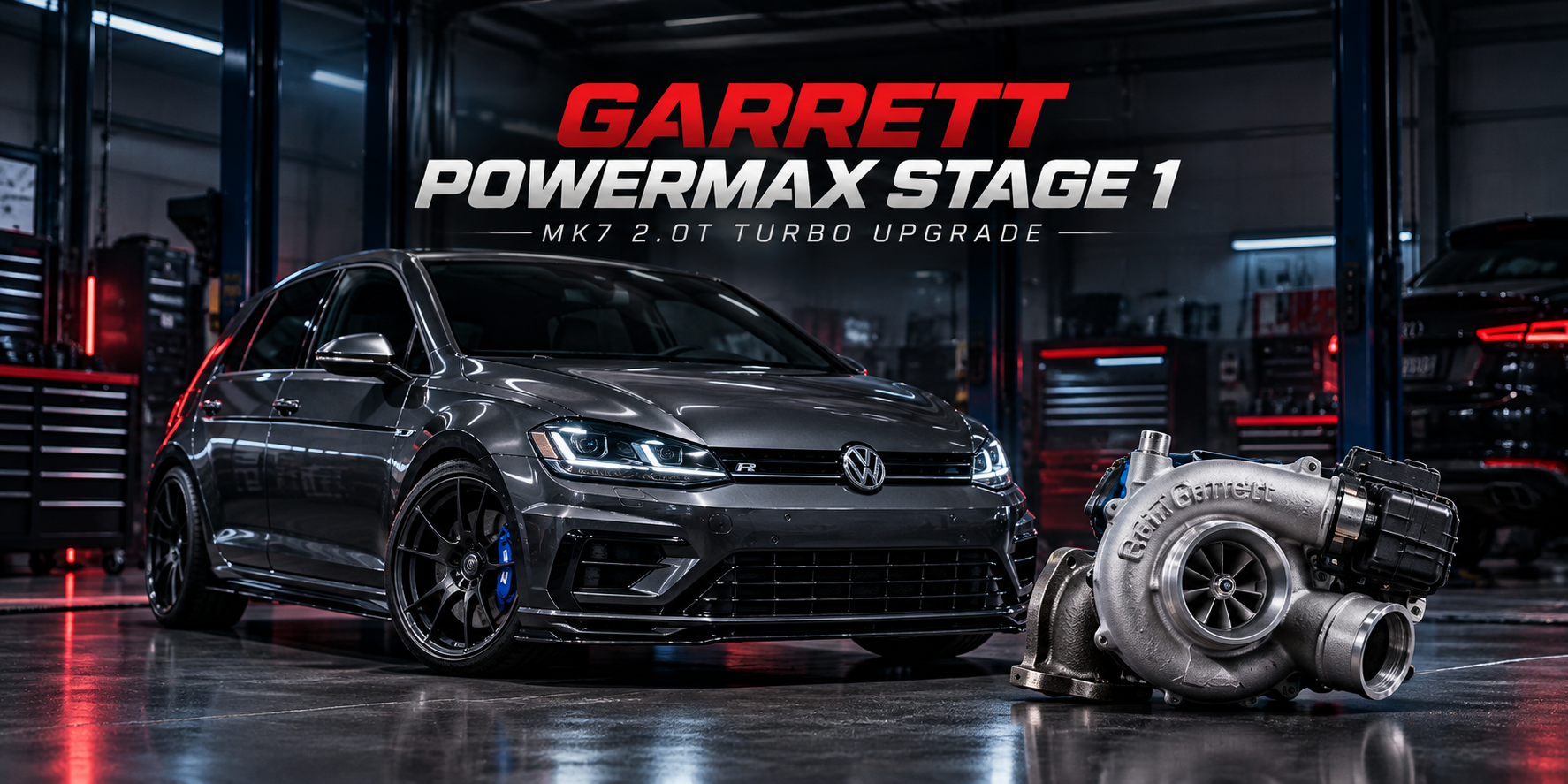
The factory turbocharger is one of the biggest factors determining how a turbocharged engine delivers power.
On the Volkswagen and Audi MQB 2.0T platform, the stock IS20 and IS38 turbos helped make cars like the GTI, Golf R, S3, A3, and TT quick from the factory. But once the build moves beyond basic bolt-ons and software, the factory turbo can become the part limiting how much airflow the engine can use.
That is where the Garrett PowerMax Stage 1 Turbocharger for the Volkswagen/Audi 2.0L TSI MK7 platform becomes interesting.
Garrett designed the Stage 1 PowerMax as a direct-fit performance turbo rather than a universal turbo that requires a completely custom installation. It is built around OEM-style packaging while providing substantially more airflow potential than the original turbocharger.
For a street-driven MK7 build, that combination can be much more useful than simply choosing the largest turbo that can physically fit in the engine bay.
What Is the Garrett PowerMax Stage 1?
The Garrett PowerMax Stage 1 is a direct-fit turbocharger upgrade for compatible Volkswagen and Audi 2.0L TSI applications based on the MQB platform.
The featured unit is Garrett part number 898199-5001W and uses the GT2260S turbo architecture.
Garrett rates the turbo for up to 485 brake horsepower under the appropriate conditions and with the necessary supporting hardware and calibration.
Direct-Fit Design
The PowerMax is designed to retain the basic installation location and connection points used by the factory turbo system.
That does not mean the entire build is plug-and-play from a tuning perspective, but it does mean the turbo itself is engineered around the factory engine platform rather than requiring a custom manifold and a fully fabricated exhaust setup.
Calibrated Electronic Actuator
The turbo comes as a complete assembly with a calibrated electronic actuator.
That is important because modern electronic wastegate control is integrated closely with the ECU's boost-management strategy.
Starting with the correct actuator setup removes one major variable from the mechanical side of the installation.
How Much Power Can the PowerMax Stage 1 Support?
Garrett rates the Stage 1 PowerMax at up to 485 hp at the flywheel.
That number should be understood as turbocharger capability, not a guaranteed dyno result for every car.
Turbo Capability Is Not Guaranteed Engine Output
Actual power depends on the complete vehicle.
Important variables include:
- ECU calibration
- Fuel quality
- Fuel system capacity
- Intake airflow
- Intercooler efficiency
- Exhaust restriction
- Engine condition
- Ambient temperature
- Boost pressure
A turbo rated for a certain power level does not force the engine to produce that number.
It simply gives the engine and tuner more airflow capacity to work with.
Why 485 HP Is a Useful Range
For many street-driven MQB cars, roughly this level of turbo capability creates an appealing middle ground.
It is substantially beyond what most owners expect from a basic stock-turbo build without automatically moving into the packaging, response, and supporting-hardware demands of a much larger motorsport-oriented turbo.
How Does It Compare With the Factory IS20 and IS38?
Volkswagen and Audi used different factory turbochargers across the MQB 2.0T lineup.
The GTI and several lower-output applications commonly use the IS20, while higher-output vehicles such as the Golf R and S3 use the larger IS38.
Compared With the IS20
For an IS20-equipped car, the PowerMax represents a major step in airflow capacity.
A tuned GTI can make impressive power on the original turbo, but eventually the compressor reaches a point where additional boost mostly creates more heat rather than useful airflow.
A larger, more efficient turbo changes that ceiling.
Compared With the IS38
The difference is still meaningful for an IS38-equipped Golf R or S3.
Garrett states that the Stage 1 PowerMax provides approximately 17 percent more compressor flow than the stock Golf R IS38.
That additional airflow gives the calibration more room to maintain power as engine speed rises instead of asking the factory turbo to operate near the edge of its efficient range.
What Is Inside the GT2260S?
The PowerMax Stage 1 uses Garrett's GT2260S configuration.
The compressor measures 47 mm at the inducer and 60 mm at the exducer, while the turbine measures 50 mm at the inducer and 45 mm at the exducer.
Those dimensions are only part of the story.
GTX Gen II Compressor Aerodynamics
Garrett incorporates GTX Gen II compressor aerodynamics into the Stage 1 design.
The goal is to improve airflow and efficiency compared with the original turbo while still packaging the unit for the MQB engine bay.
High-Temperature Turbine Materials
The turbine wheel uses a high-temperature Mar-M alloy, and Garrett pairs it with a twin-scroll stainless-steel turbine housing.
Garrett rates the turbine-side hardware for temperatures up to 1050°C.
That thermal capacity matters because a modified turbocharged engine can generate substantial exhaust heat under sustained load.
Journal-Bearing Rotating Group
The Stage 1 uses Garrett's latest-generation journal-bearing rotating group with a reinforced 360-degree thrust bearing.
A journal-bearing turbo is not automatically inferior to a ball-bearing turbo. The complete design, intended power range, packaging, oiling, and response characteristics all matter.
Will the PowerMax Stage 1 Spool Like the Stock Turbo?
Any time turbo size and airflow capacity increase, response becomes part of the discussion.
A larger turbo generally has more rotating mass and airflow capability than the smaller turbo it replaces.
That can change when boost arrives and how the engine feels through the RPM range.
Do Not Judge the Turbo Only by Peak Boost
Turbo response is influenced by more than turbo dimensions.
Calibration, gear selection, exhaust flow, engine load, intake temperature, throttle position, and even transmission behavior all affect how quickly the turbo reaches its requested boost target.
The goal of a good street setup is not necessarily to make full boost at the lowest RPM possible.
The goal is a useful powerband that matches how the car is driven.
More Top-End Headroom
The reason to move to a larger turbo is usually not to make the engine behave exactly like the original one.
It is to gain airflow capacity at the point where the original turbo begins running out of breath.
For an enthusiast who wants stronger midrange and high-RPM power without moving to a fully custom big-turbo arrangement, that tradeoff can be worthwhile.
Does the PowerMax Stage 1 Require a Tune?
Yes. A turbo upgrade of this scale should be installed as part of a properly calibrated performance package.
The ECU needs to manage boost control, fueling, ignition timing, throttle behavior, and numerous protection strategies around the new turbocharger.
Do Not Run Big-Turbo Hardware on the Wrong Calibration
A factory ECU calibration was designed around the airflow behavior and boost characteristics of the original turbo.
Installing a significantly different turbo without the appropriate calibration is not a reasonable shortcut.
The tuner should know the exact Garrett part number and the complete supporting-mod list before calibration begins.
Transmission Tuning May Matter Too
DSG-equipped vehicles can also benefit from transmission calibration when engine torque increases substantially.
Clutch-pressure strategy, shift behavior, torque limits, and gear selection all influence how effectively the car uses the additional engine output.
Manual-transmission cars may instead require attention to clutch capacity as torque rises.
What Supporting Mods Should You Plan?
A turbocharger does not operate independently.
Increasing airflow through the compressor means the rest of the engine system needs to support that increase.
Intake System
The compressor needs a clean, low-restriction source of air.
For compatible MK7 applications, an intake such as the aFe Magnum FORCE Stage-2 Pro 5R intake for the MK7 Volkswagen 2.0T platform can be part of a larger airflow package.
The aFe system uses a large radial-flow filter, heat-resistant intake tubing, and the factory fresh-air scoop while retaining direct-fit installation on compatible applications.
The exact intake needs to be confirmed against the specific GTI, Golf R, A3, or S3 configuration before ordering.
Intercooler
Compressing air creates heat.
As turbocharger output rises, charge-air cooling becomes increasingly important.
A larger or more efficient intercooler helps control intake-air temperature during repeated pulls, hot-weather driving, and sustained load.
Lower and more stable intake temperatures give the ECU and tuner a more consistent environment to work with.
Fueling
More airflow requires enough fuel to maintain the commanded air-fuel ratio.
The fueling solution depends on the power target, fuel type, calibration, and exact engine configuration.
Do not assume the factory fuel system supports every output level the turbocharger itself can flow.
Exhaust Flow
The turbine also needs an efficient exhaust path.
Downpipe configuration, catalyst restriction, cat-back design, emissions rules, and noise requirements should all be considered as part of the build.
GTI or Golf R: Does the Same Turbo Make Sense for Both?
The PowerMax can apply across multiple MQB 2.0T vehicles, but the starting point is not identical.
MK7 GTI
A GTI usually begins with an IS20 turbo and front-wheel drive.
Moving to a turbo capable of substantially more airflow means traction becomes a major part of the build.
A GTI making significantly more torque may need:
- Better tires
- Improved engine and transmission mounts
- A limited-slip differential where applicable
- Suspension tuning
- Clutch or DSG calibration
You can browse the broader Volkswagen GTI performance catalog at Elite Performance when planning the rest of the chassis and drivetrain around the new power level.
MK7 Golf R
The Golf R starts with the larger IS38 turbo and all-wheel drive.
That means the jump in turbo size is less dramatic than it is on an IS20 GTI, but the chassis is generally better prepared to put additional power to the ground.
The PowerMax gives the Golf R additional airflow headroom while retaining the direct-fit approach.
For supporting brakes, suspension, drivetrain, and engine parts, the Volkswagen Golf R catalog provides a clean vehicle-specific starting point.
What About Audi A3 and S3 Applications?
The same MQB 2.0T architecture appears in several Audi applications.
Garrett lists compatibility across specific A3, A3 Quattro, S3, TT, and TTS configurations in addition to Volkswagen models.
Exact Fitment Still Matters
Shared engine architecture does not mean every model year and trim uses identical hardware.
Before ordering, verify:
- Model year
- Engine code
- Original turbocharger
- Drivetrain
- Vehicle market
- Existing modifications
The individual Garrett PowerMax product page at Elite Performance should be used as the final product reference before purchasing.
Stage 1 or a Bigger Turbo?
One of the easiest mistakes in performance modification is choosing hardware based entirely on the biggest horsepower number available.
Turbo selection should start with the way the car will actually be used.
Stage 1 Makes Sense If...
- The car is primarily street driven
- You want substantially more power than the factory turbo can comfortably support
- OEM-style fitment matters
- You want to retain a broad usable powerband
- You are not trying to build the highest-power MQB car possible
A Larger Turbo May Make More Sense If...
- Your horsepower target is beyond the Stage 1 turbo's intended range
- The engine is already being built internally
- Maximum high-RPM airflow matters more than factory-like response
- You are prepared for more extensive fueling and supporting modifications
- The car is primarily a competition or high-power project
The best turbo is not the one with the largest compressor wheel. It is the one that matches the engine and the intended powerband.
Why Does Turbo Speed Matter?
A turbocharger can be damaged by overspeeding even when boost pressure does not appear extreme.
Garrett specifies a maximum allowable speed of 185,000 rpm for the Stage 1 PowerMax.
Boost Pressure Does Not Tell the Whole Story
Turbo shaft speed depends on airflow, pressure ratio, temperature, engine demand, and operating conditions.
A turbo may need to spin much harder to produce the same boost in one situation than another.
Stay Inside the Compressor's Operating Range
This is another reason proper calibration matters.
The tune should be developed around the compressor map and the turbo's safe operating limits rather than simply requesting more boost until the dyno number stops increasing.
Garrett machines the compressor housing for an optional turbo-speed sensor for builders who want to monitor shaft speed directly.
What Should You Check Before Installing a Turbo Upgrade?
A bigger turbo is a poor investment if the underlying engine is unhealthy.
Before installation, evaluate the condition of the platform.
Engine Health
Depending on mileage and build history, it may be sensible to inspect:
- Compression
- Oil consumption
- Cooling-system condition
- Ignition components
- PCV system
- Existing boost leaks
- Oil leaks
Maintenance Matters More as Power Rises
A modified turbo engine has less tolerance for neglected plugs, weak ignition components, poor-quality fuel, overheating, or inadequate oil maintenance.
Adding power does not fix maintenance problems. It usually exposes them faster.
What Should You Check Before Ordering?
Before buying the Garrett PowerMax Stage 1, confirm:
- Exact year, make, model, and trim
- EA888 engine configuration
- Factory turbocharger
- Required ECU calibration
- Fuel system capability
- Intercooler setup
- Intake system
- Exhaust configuration
- Clutch or DSG capacity
- Local emissions requirements
- Your realistic horsepower goal
Do Not Build Around the Turbo Alone
A turbocharger is only one component in the airflow system.
A well-matched 450-hp package with good cooling, fueling, calibration, tires, and brakes can be a much better car than a poorly planned build chasing a larger peak number.
Is the Garrett PowerMax Stage 1 Worth Considering?
For a modified MK7-platform Volkswagen or Audi that has outgrown the factory IS20 or IS38, the PowerMax Stage 1 occupies an attractive part of the market.
It provides significantly more airflow capacity while retaining the direct-fit philosophy of the original turbo system.
Garrett rates the GT2260S-based unit for up to 485 flywheel horsepower, equips it with a calibrated electronic actuator, uses high-temperature turbine materials, and designs it specifically around the MQB 2.0T platform.
That does not make it a complete 485-hp kit by itself.
What it gives you is the turbocharger foundation for a build in that range.
Build the Entire Car Around the New Power Level
The best turbo upgrade is the one that makes the car better as a complete package.
If your GTI spins through the lower gears, the next upgrade may be tires and chassis setup. If your Golf R heat-soaks after one hard pull, cooling may matter more than another few pounds of boost. If the fuel system is approaching its limit, solving that becomes more important than chasing the next dyno number.
Start with a realistic power goal and build outward from there.
If the PowerMax Stage 1 matches that goal, you can view the Garrett PowerMax Stage 1 at Elite Performance.
You can also browse Garrett performance parts or compare the broader Garrett forced-induction lineup as you plan the rest of the build.