GSC S2 Camshafts: What They Change in a Subaru EJ20 Build
Camshafts can completely change how a turbocharged Subaru engine makes power, but they are not a simple bolt-on horsepower part. Here’s how GSC Power Division S2 cams affect airflow, RPM range, tuning, valvetrain demands, and the rest of an EJ20 performance build.
Most bolt-on performance parts work around the outside of an engine.
Intakes help air get in. Exhaust systems help gases get out. Intercoolers manage heat. Tuning changes how the ECU uses the hardware already installed.
Camshafts go deeper.
They directly control when the engine's valves open, how long they remain open, and how the cylinder head moves air through the engine.
That makes a camshaft upgrade one of the more serious steps in a turbocharged Subaru build—and one of the upgrades that should be chosen around the entire engine combination rather than installed by itself.
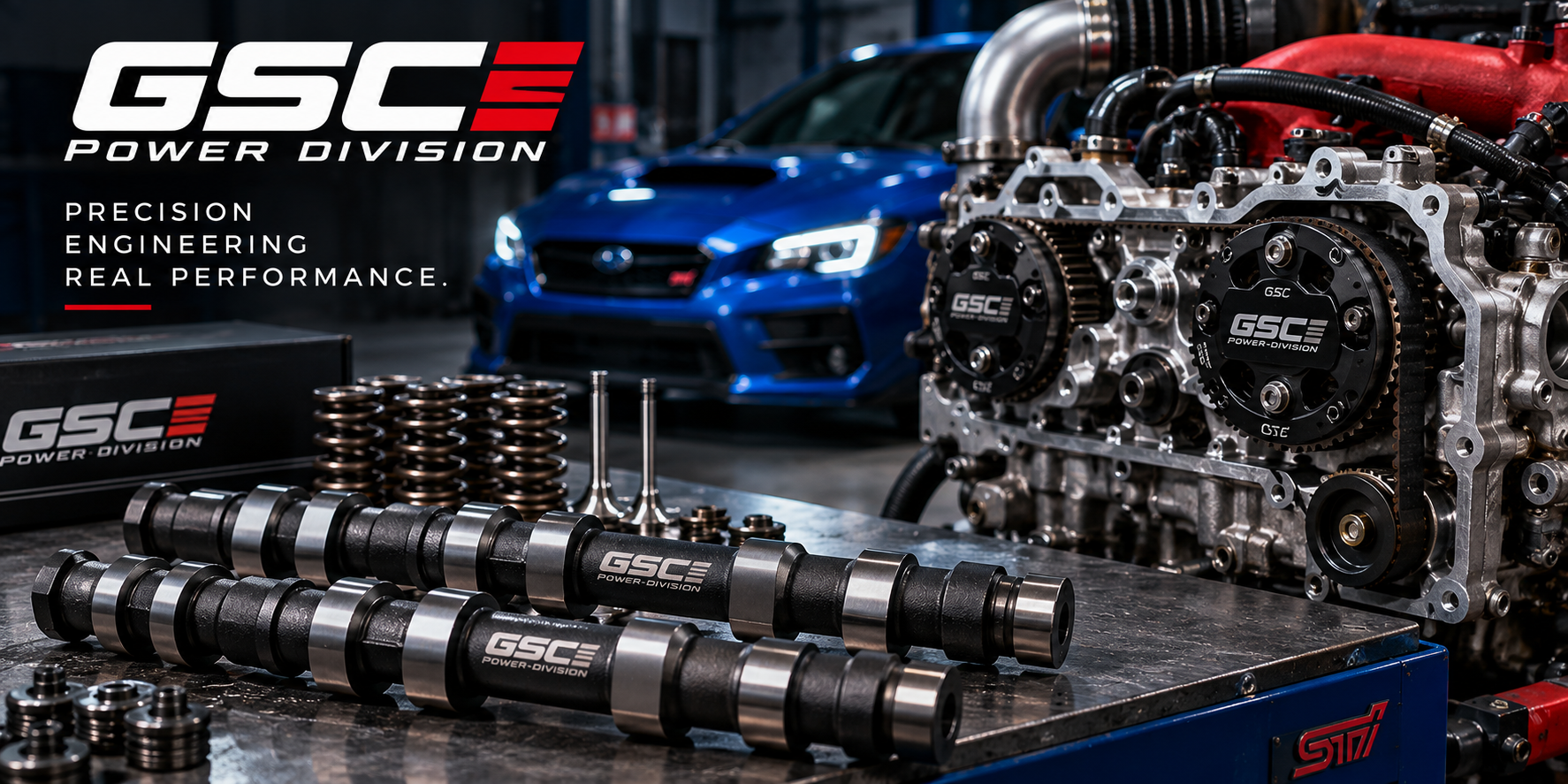
The GSC Power Division EJ20 JDM/Euro-Spec STI S2 272/272 Billet Camshafts are a good example of what happens when a build moves beyond simple bolt-ons and starts addressing airflow inside the cylinder head.
What Does a Camshaft Actually Do?
A four-stroke engine depends on precise control of the intake and exhaust valves.
The camshafts determine when those valves open and close as the engine moves through its intake, compression, combustion, and exhaust cycles.
Changing the cam profile changes how the engine breathes.
Valve Timing
Valve timing describes when the intake and exhaust valves begin opening and when they close relative to piston position.
Changing those events can alter cylinder filling, exhaust scavenging, turbo response, idle quality, and where in the RPM range the engine is most efficient.
Duration
Duration describes how long a valve remains open.
A camshaft designed to keep the valves open longer can help an engine move more air at higher RPM, but that does not automatically mean it will improve every part of the powerband.
The cam has to match the engine's turbocharger, heads, displacement, compression, exhaust system, and intended operating range.
Lift
Lift describes how far the valve is opened from its seat.
More lift can expose more valve area to airflow, but the cylinder head, springs, retainers, piston-to-valve clearance, and the rest of the valvetrain all have to support the additional movement.
What Are GSC S2 Camshafts?
GSC Power Division produces performance camshafts and valvetrain components for a wide range of turbocharged and naturally aspirated platforms.
The specific set featured here carries GSC's S2 designation and a 272/272 specification for compatible Subaru EJ20 JDM and European-spec STI applications.
The cams are billet components designed for performance engine builds rather than a factory-replacement maintenance part.
You can browse the broader GSC Power Division catalog at Elite Performance to compare camshafts, valves, guides, and other valvetrain components.
Why the 272/272 Designation Matters
The number gives builders an indication of the camshaft's duration category and immediately signals that this is not intended to behave like a stock cam profile.
A performance cam in this range is generally chosen when the build is intended to move more air and continue making power higher in the RPM range than the original engine configuration.
That does not mean every EJ20 build needs a 272 cam.
The right cam depends on the engine.
How Can Cams Change the Powerband?
One of the biggest misconceptions about camshafts is that they simply add horsepower everywhere.
In reality, a camshaft helps determine where the engine makes power.
Higher-RPM Airflow
A larger performance cam can allow the cylinder head to continue moving air effectively at engine speeds where the factory cams may become more restrictive.
This is valuable on builds using a larger turbocharger that continues flowing efficiently at higher RPM.
Low-RPM Tradeoffs
A cam optimized for higher engine speeds may not provide the same characteristics at low RPM as the stock cam.
Depending on the combination, changes may be noticeable in:
- Idle quality
- Low-RPM response
- Turbo spool behavior
- Vacuum
- Part-throttle drivability
This is why cam selection should follow the build's intended use rather than the assumption that a larger cam is always better.
When Does an EJ20 Build Actually Need Camshafts?
A lightly modified street car usually has very different airflow demands than a built engine using a large turbocharger.
Camshafts become more relevant as the rest of the engine starts moving beyond the capacity of the factory valvetrain and cylinder-head combination.
Larger Turbo Builds
A larger turbocharger can move substantially more air than the factory unit.
That extra compressor capacity only helps if the rest of the engine can efficiently move the air through the intake, cylinder head, combustion chamber, and exhaust.
At some point, improving cylinder-head airflow becomes part of making effective use of the larger turbo.
Higher-RPM Builds
Engines intended to operate at higher RPM place additional demands on airflow and valvetrain control.
A performance camshaft may be chosen to complement that operating range.
Built Cylinder Heads
Ported heads, upgraded valves, improved valve springs, and other cylinder-head work can change how much airflow the engine is capable of supporting.
A camshaft should be selected to work with those components instead of being chosen independently.
What Supporting Mods Should You Consider?
Camshafts are rarely the only internal engine component involved in a serious build.
If you are planning the engine from the cylinder heads inward, it is worth looking through the engine components available at Elite Performance rather than treating the cams as an isolated purchase.
Valve Springs
Valve springs have to maintain control of the valve as engine speed increases.
If the spring cannot keep the valvetrain following the cam profile accurately, valve float can occur.
The correct spring pressure depends on the camshaft, valve mass, RPM target, and complete cylinder-head setup.
Retainers
Retainers secure the spring assembly at the top of the valve.
Performance builds may use upgraded retainers as part of a complete spring package, particularly where RPM and valvetrain loads increase significantly.
Valves
GSC also produces upgraded intake and exhaust valves for multiple Subaru engine families.
Replacing or upgrading valves can make sense during a cylinder-head rebuild, especially when the engine is being prepared for greater heat, boost, RPM, or airflow.
Valve Guides and Seals
Guide condition matters whenever a cylinder head is apart.
Worn guides can allow unwanted valve movement, while damaged or hardened seals can contribute to oil consumption.
If the head is already being rebuilt for cams and springs, inspecting the entire valvetrain is usually more sensible than replacing only the most visible parts.
Do GSC S2 Cams Require Tuning?
A major camshaft change should be planned around engine calibration.
The ECU controls fueling, ignition, boost, variable valve timing where applicable, idle behavior, and other parameters that interact directly with the engine's airflow.
Airflow Has Changed
The reason for installing performance cams is to change how the engine breathes.
Once airflow characteristics change, calibration may need to change with them.
Idle and Low-Speed Operation
A tuner may need to account for changes in airflow at idle and lower engine speeds as well as the increased airflow available higher in the rev range.
Do Not Tune Around the Wrong Hardware
The tuner should know the exact camshaft specification, turbocharger, injectors, fuel system, compression ratio, boost target, and other major engine changes before calibration begins.
A strong tune cannot correct a poorly matched mechanical combination.
How Do Camshafts Work With a Bigger Turbo?
The turbocharger and camshafts should complement one another.
A very large turbo on an engine that cannot efficiently move air through the cylinder head can leave performance on the table.
At the same time, aggressive cams on a small, quick-spooling street turbo may shift the engine's characteristics farther up the rev range than the owner actually wants.
Street Turbo Combination
A street-focused car often prioritizes response and a broad usable torque curve.
For that type of build, the goal is usually to improve airflow without sacrificing the reason the car is enjoyable at normal road speeds.
High-Power Combination
A larger turbo built around high-RPM airflow can benefit more from cylinder-head and camshaft upgrades because the rest of the system is capable of using the additional flow.
This is where engine components stop being individual modifications and start functioning as one package.
What About Piston-to-Valve Clearance?
Internal clearance is one of the reasons a camshaft installation is very different from a simple bolt-on modification.
When lift, duration, cam timing, cylinder heads, pistons, or block dimensions change, piston-to-valve clearance must be considered.
Do Not Assume Clearance
A component physically bolting into the cylinder head does not prove the complete engine has enough operating clearance.
Built engines may use different:
- Pistons
- Head gaskets
- Deck heights
- Cylinder heads
- Valve sizes
- Cam timing
Those variables can all influence available clearance.
Measure the Actual Engine
For a serious engine build, critical clearances should be physically measured during assembly.
Do not base an expensive engine on assumptions taken from another car's parts list.
Fitment Matters More Than the Subaru Badge
This is especially important with the GSC S2 cams featured in this article.
The GSC EJ20 S2 272/272 camshaft listing is specifically identified as a JDM / European-spec application and not compatible with USA-spec engines.
That distinction should not be ignored.
EJ20 Does Not Automatically Mean EJ20
Subaru used different engine configurations across model years and markets.
Two cars may both be described generally as having an EJ20 while using cylinder heads, variable valve-timing arrangements, camshaft specifications, and other hardware that are not interchangeable.
Verify the Exact Engine
Before ordering cams, confirm:
- Engine code
- Vehicle market
- Model year
- Cylinder-head configuration
- AVCS configuration
- Camshaft compatibility
- Existing internal modifications
Owners comparing the rest of the platform can browse the Subaru WRX performance parts catalog, but engine-internal fitment should still be confirmed at the individual product level.
Street Build or Race Build?
The answer has a major effect on whether an aggressive camshaft makes sense.
Street-Focused EJ20
A street car needs to spend most of its life below redline.
Cold starts, traffic, part-throttle response, turbo spool, fuel quality, emissions requirements, and normal drivability all matter.
If a smaller cam meets the airflow needs of the turbo and power target, installing something more aggressive simply because it sounds impressive may make the car worse for its actual use.
Track or High-RPM Build
A competition-oriented build can place a greater priority on upper-RPM power because the engine spends more time operating near the top of the rev range.
That may justify a more aggressive cam and valvetrain package.
Drag or Roll-Racing Build
High-power straight-line applications often use larger turbochargers and may be designed specifically to stay within a narrower high-RPM powerband under load.
Those builds can benefit from a valvetrain selected around the turbo and intended shift points.
What Should You Check Before Ordering Cams?
Camshafts are one of those parts where planning first can save a very expensive second purchase.
Before ordering, know:
- Your exact engine code and market
- Your turbocharger
- Your horsepower target
- Your intended RPM limit
- Your compression ratio
- Your cylinder-head configuration
- Your valve and spring setup
- Your intended fuel
- Your tuning solution
- Your primary use: street, track, drag, or mixed
Choose the Cam Last, Not First
The camshaft should be chosen around the engine combination.
If you know the turbo, cylinder head, compression, RPM range, and power goal, choosing a cam becomes much easier.
If the entire build is being designed around a camshaft chosen because its duration number sounded aggressive, the process is backwards.
Are GSC S2 Camshafts Worth It?
For the correct engine and the correct build, performance camshafts can unlock airflow that the rest of a serious turbo setup is capable of using.
But cams are not the same kind of modification as an intake or cat-back exhaust.
They belong in a coordinated engine package that considers cylinder-head flow, turbo sizing, valvetrain stability, tuning, internal clearances, and intended RPM range.
The GSC S2 272/272 cams featured here make the most sense when the engine combination actually needs the additional airflow and when the exact JDM/Euro-spec fitment has been confirmed.
If the rest of the build is still close to stock, there may be more useful places to spend the budget first.
Build the Engine as a Complete System
The best engine builds are rarely created by choosing the largest version of every part.
A responsive turbo, correctly sized cams, proper valvetrain components, adequate fueling, effective cooling, and a well-developed calibration need to work together.
That is how an engine becomes more than a collection of expensive parts.
If your EJ20 build has reached the point where cylinder-head airflow is becoming part of the plan, view the GSC Power Division S2 272/272 EJ20 camshafts at Elite Performance.
You can also browse GSC Power Division or explore the complete engine-components catalog to plan the rest of the build around the same goal.