GSC S58 Valve Springs: When a High-Boost BMW Actually Needs Them
The BMW S58 can make enormous power on upgraded turbos, but higher boost and RPM place much greater demands on the valvetrain. Here’s how the GSC beehive valve spring and titanium retainer kit improves valve control, what its 70 PSI and 9,000 RPM ratings actually mean, and when an S58 build should upgrade beyond the factory springs.
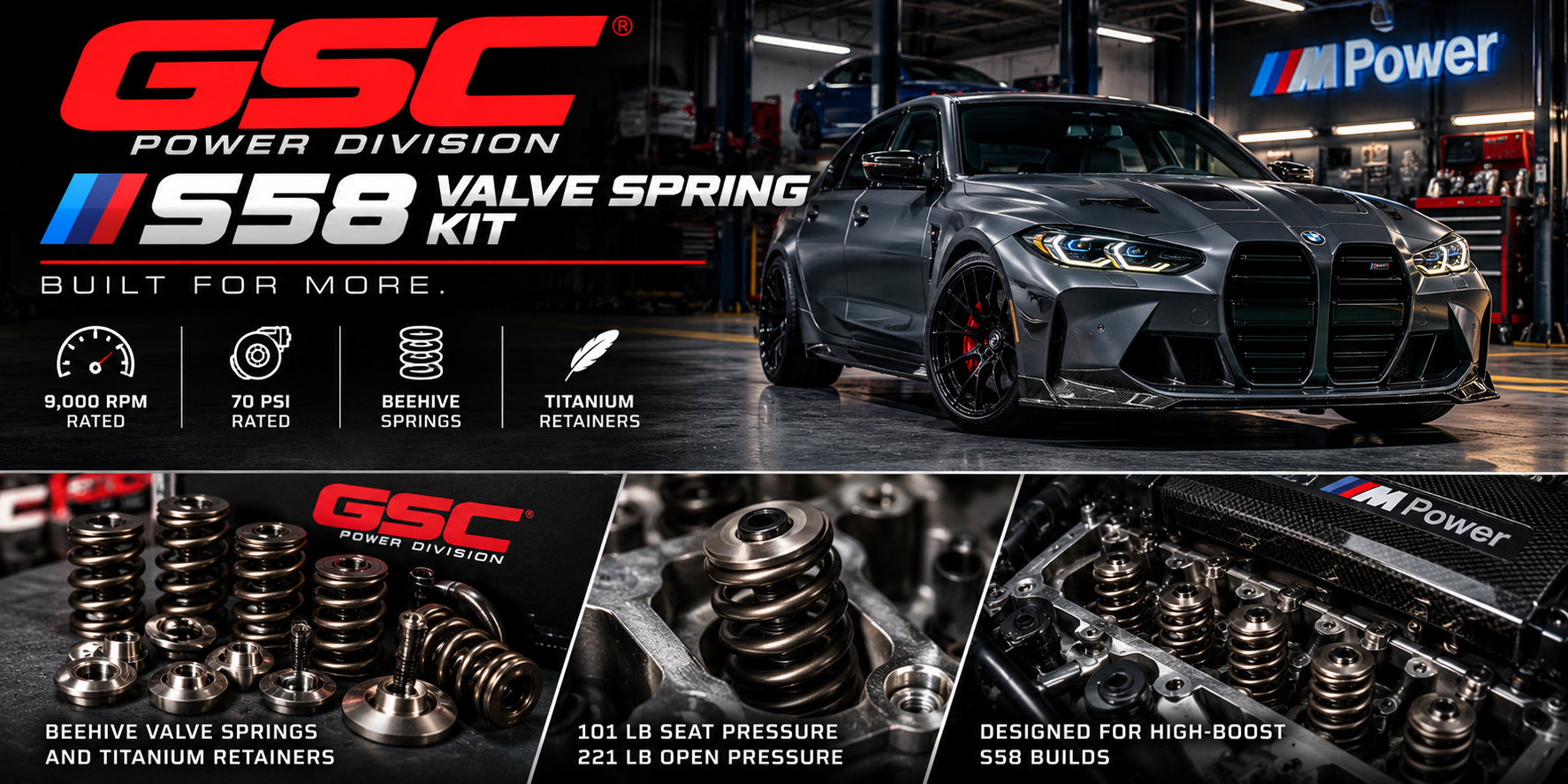
The BMW S58 is capable of making enough power that some upgrades do not become necessary until the rest of the engine has already moved far beyond stock.
Valve springs are a perfect example.
A stock or mildly modified M2, M3, or M4 does not need an aggressive valvetrain package simply because stronger parts exist. But once a build moves into larger turbochargers, significantly higher boost, elevated RPM, upgraded camshafts, or extensive cylinder-head work, the factory springs can become one of the components that deserves closer attention.
The GSC Power Division BMW S58 Beehive Valve Spring & Titanium Retainer Kit is designed for exactly that level of build.
GSC rates the kit for up to 9,000 RPM and 70 PSI of boost, with 24 beehive springs and 24 titanium retainers supporting the S58's 24-valve cylinder head.
Those numbers sound impressive, but they are also easy to misunderstand.
A 70 PSI rating does not mean your BMW should run 70 PSI. A 9,000 RPM rating does not mean the engine should automatically be revved to 9,000. Those are component capability limits that still have to be considered alongside the turbochargers, camshafts, valves, engine internals, cylinder head, tuning, fueling, and intended use of the complete build.
What Do Valve Springs Actually Do?
Every intake and exhaust valve in the S58 is opened mechanically by the valvetrain and then has to close accurately as the engine rotates.
The valve spring is responsible for maintaining control of that valve and keeping the valvetrain following the intended camshaft profile.
That job becomes increasingly difficult as engine speed, valve lift, boost pressure, and valvetrain acceleration increase.
Closing the Valve
When the cam lobe moves past its peak, the spring forces the valve back toward its seat.
The spring needs enough force to keep the valve following the cam profile rather than allowing the valvetrain to lose control.
Maintaining Contact
At high RPM, the valvetrain is changing direction extremely quickly.
If spring force is insufficient for the combination, components can separate from the intended cam motion.
That is where conditions such as valve float can begin.
What Is Valve Float?
Valve float occurs when the valvetrain can no longer accurately follow the camshaft profile at higher engine speed.
The spring does not control the valve quickly enough, allowing the valve to remain open or move differently from what the camshaft intended.
Why Valve Float Is a Problem
Loss of valve control can cause:
- Reduced power
- Misfires
- Inconsistent combustion
- Valve-to-piston contact in severe cases
- Damage to valvetrain components
On a high-dollar S58 build, valvetrain instability is not something you want to discover at full load near redline.
RPM Makes the Problem Harder
The forces involved in the valvetrain rise dramatically as engine speed increases.
A setup that works perfectly at factory RPM may need additional spring control if the engine is expected to operate substantially higher in the rev range.
Why Does Boost Pressure Affect Valve Springs?
Boost does more than increase cylinder pressure after the valve closes.
Pressure in the intake tract also acts against the intake valve.
As boost pressure rises, the valve spring has to work against additional pressure trying to influence the valve's movement.
High Boost Adds Load
On a lightly modified S58, this may never become a meaningful limitation.
On a very high-boost build, the pressure acting across the valve area becomes much more significant.
This is one reason GSC specifically publishes a maximum boost rating for the spring package.
70 PSI Is a Capability Rating
The GSC S58 spring kit is rated for applications up to 70 PSI.
That should not be interpreted as a recommendation to run an S58 at 70 PSI.
The safe boost level of an actual engine depends on far more than its valve springs.
Turbocharger efficiency, combustion pressure, rods, pistons, head sealing, fueling, cooling, tuning, and many other variables determine what the complete engine can safely tolerate.
What Is a Beehive Valve Spring?
A beehive spring changes diameter along its length rather than maintaining the same outside diameter from top to bottom.
The upper portion of the spring is narrower, creating the characteristic beehive shape.
That geometry can provide several benefits in a performance valvetrain.
Smaller Retainer
Because the top of the spring is narrower, it can use a smaller-diameter retainer.
A smaller retainer can reduce mass at the top of the valve assembly.
Lower Moving Mass
Reducing valvetrain mass makes it easier for the spring to control the valve at high RPM.
The less mass the spring has to accelerate and decelerate, the easier it becomes to maintain accurate valve motion.
Spring Stability
The varying coil diameter can also change the spring's natural frequencies, helping reduce the tendency for all of the coils to resonate together under certain operating conditions.
This is one reason beehive designs have become common in serious performance valvetrain applications.
Why Does GSC Use Titanium Retainers?
The GSC kit pairs the springs with titanium retainers.
The retainer sits at the top of the spring and locks the spring assembly to the valve.
Because it moves every time the valve moves, its mass matters.
Reducing Reciprocating Mass
Titanium provides high strength while allowing the retainer to be significantly lighter than many steel alternatives.
Reducing mass at the top of the valve helps improve high-RPM control.
Spring Pressure Is Only Part of the Equation
One way to control a valvetrain is simply to use more spring pressure.
But excessive spring pressure creates additional loads on the rest of the valvetrain.
Reducing component mass helps improve control without relying solely on increasingly stiff springs.
What Are the GSC S58 Spring Specifications?
GSC's part number 5023 is designed specifically for the BMW S58 valvetrain.
Published specifications include:
- 24 beehive valve springs
- 24 titanium retainers
- 101 lb seat pressure at 1.415-inch installed height
- 221 lb open pressure at approximately 11 mm valve lift
- Maximum valve lift around 0.433 inch
- Maximum rated engine speed: 9,000 RPM
- Maximum rated boost: 70 PSI
These numbers are useful for an engine builder because they describe the operating window of the spring.
They are not a substitute for physically measuring the completed cylinder head.
What Is Installed Height?
Installed height is the distance occupied by the valve spring when the valve is closed and the complete spring, seat, retainer, and lock assembly is installed.
It directly affects spring pressure.
Why Installed Height Matters
A spring compressed farther at rest will generally produce more seat pressure.
A spring installed taller will generally produce less.
That means the exact cylinder-head setup matters even when using the correct part number.
Measure the Actual Head
Valve jobs, replacement valves, spring seats, retainers, locks, cylinder-head machining, and manufacturing tolerances can all influence installed height.
A serious engine build should measure each position rather than assuming every spring automatically lands at the published specification.
What Is Seat Pressure?
Seat pressure is the force the spring applies when the valve is fully closed.
GSC specifies approximately 101 pounds at the published 1.415-inch installed height for this S58 kit.
Why Seat Pressure Matters
The spring needs sufficient force to keep the valve closed and maintain control as cylinder-head pressure and RPM increase.
Too little spring pressure can contribute to instability.
Too much spring pressure can unnecessarily increase wear and stress elsewhere in the valvetrain.
The correct value depends on the entire combination.
What Is Open Pressure?
Open pressure describes spring force when the valve is near maximum lift.
As the camshaft pushes the valve farther open, the spring compresses and spring force rises.
GSC specifies approximately 221 pounds at around 11 mm of lift for the S58 kit.
Camshaft Lift Matters
If an aftermarket camshaft uses more lift than the factory profile, the spring compresses farther.
That changes open pressure and reduces remaining clearance before coil bind.
This is why camshaft and spring selection should be planned together.
What Is Coil Bind?
Coil bind occurs when the spring compresses so far that the coils physically contact one another and the spring cannot compress any farther.
This is an absolute mechanical limit—not something the valvetrain should approach during normal operation.
Why Coil-Bind Clearance Matters
If the camshaft attempts to open the valve beyond the available spring travel, the valvetrain can experience extreme loads and potentially catastrophic damage.
Every high-lift camshaft installation should verify adequate spring travel and coil-bind clearance.
Do Not Assume Compatibility From the Brand Name
A GSC camshaft and a GSC spring kit still need to be verified as a complete combination.
The actual installed height, maximum lift, retainer, valve, cylinder head, and machining determine the final geometry.
Does a Stock S58 Need Upgraded Valve Springs?
Generally, a factory or lightly modified S58 does not need an upgraded spring package simply because one is available.
BMW designed the original valvetrain around the factory cams, boost level, RPM range, and expected durability requirements.
The GSC kit becomes relevant when those operating conditions change substantially.
Stock-Turbo Street Car
If the vehicle has basic bolt-ons and a conservative tune while remaining within normal engine-speed limits, upgraded valve springs may provide little practical benefit.
Upgraded Turbo Build
A larger turbocharger capable of sustaining significantly more airflow and boost at high RPM changes the equation.
This is where valvetrain control starts becoming part of the complete engine strategy.
High-RPM Build
If the tuner and engine builder intend to extend the usable RPM range beyond the factory operating window, spring capability becomes increasingly important.
When Should an S58 Build Upgrade Valve Springs?
Valve springs should be selected around the build rather than installed according to one universal horsepower threshold.
They become more relevant when the engine has one or more of the following:
- Larger turbochargers
- Very high boost
- Higher RPM limit
- Performance camshafts
- Increased valve lift
- Ported cylinder head
- Extended high-RPM track use
- Drag-racing or roll-racing use
A qualified S58 engine builder should determine whether the factory springs remain appropriate for the actual combination.
What About Upgraded Camshafts?
Camshafts and valve springs are closely related.
A camshaft changes how far, how quickly, and how long the valve moves.
A more aggressive profile can place substantially greater demands on the spring.
More Lift
Additional lift compresses the spring farther.
This increases open pressure and reduces the available distance to coil bind.
More Aggressive Acceleration
Two camshafts with similar maximum lift can still move the valve at different rates.
A profile that accelerates the valve more aggressively requires the spring to maintain control through those faster changes in motion.
Higher RPM
Many performance camshafts are intended to improve airflow at engine speeds where the factory cams begin becoming restrictive.
That often means the valvetrain is simultaneously being asked to operate at higher RPM.
This is why cams, springs, retainers, turbochargers, and RPM targets should be planned as one system.
Why Are Valve Springs Relevant on an Upgraded-Turbo S58?
A larger turbo can continue moving air efficiently at engine speeds where the factory turbo may already be approaching its useful limit.
That encourages builders to extend the powerband higher.
The engine may therefore experience both:
- Higher boost pressure
- Higher engine speed
Those are exactly the conditions that make valvetrain control more difficult.
The GSC S58 spring and titanium-retainer kit is designed to give engine builders additional margin for that type of combination.
Does Installing Valve Springs Add Horsepower?
Not by themselves.
Valve springs are a supporting component.
A stronger spring does not automatically make the cylinder head flow more air or command additional boost.
The Benefit Is Control
The spring allows the valvetrain to continue operating accurately under conditions that may exceed the intended range of the factory hardware.
If the stock spring is already fully capable of controlling the valve at your boost and RPM level, replacing it will not suddenly add meaningful power.
Supporting Parts Enable the Combination
This is similar to upgrading the fuel system on a high-power car.
Larger injectors do not automatically create horsepower either.
They create the capacity necessary for another component—the turbocharger and calibration—to produce more power safely.
Does 9,000 RPM Mean You Should Rev an S58 to 9,000?
No.
The spring's 9,000 RPM rating describes the spring package's intended capability, not the safe limit of the complete S58 engine.
The maximum safe engine speed also depends on:
- Connecting rods
- Pistons
- Rod bearings
- Crankshaft
- Oil system
- Camshaft profile
- Valve mass
- Turbocharger powerband
- Balancing
- ECU calibration
An engine should not be given a higher rev limit simply because one valvetrain component carries a higher rating.
Which BMWs Use the S58?
The S58 powers several modern BMW M applications, including vehicles from the M2, M3, M4, X3 M, and X4 M families depending on model year and market.
That does not mean every S58 component should be ordered solely by vehicle badge.
Verify the Exact Engine and Combination
Internal engine components require more care than a cosmetic bolt-on.
Confirm the exact engine, cylinder-head configuration, camshaft combination, and intended use before purchasing valvetrain hardware.
You can browse the broader BMW M2 parts catalog, BMW M3 parts catalog, or BMW M4 parts catalog at Elite Performance when planning the rest of the build.
Should You Upgrade Valve Springs While the Head Is Apart?
If the cylinder head is already removed for cams, porting, valve work, or an engine build, that is the logical time to evaluate the complete valvetrain.
Labor is a major part of an internal engine modification.
Inspect the Entire Valvetrain
A builder should inspect and measure:
- Valve condition
- Valve guides
- Valve seals
- Spring installed height
- Spring pressure
- Retainers
- Locks
- Camshafts
- Clearance at maximum lift
Installing stronger springs while ignoring worn or incorrectly sized mating components defeats the purpose of building a controlled valvetrain.
What Does Installation Involve?
This is not an intake installation.
Valve-spring replacement requires specialized tools, careful timing work, and accurate measurement.
Whether the job is performed with the cylinder head installed or removed depends on the engine builder's process and what other work is being performed.
The Valve Cannot Fall Into the Cylinder
During an on-engine spring change, the valve needs to remain supported while the retainer and locks are removed.
Professional techniques may use compressed air or other methods depending on the engine and tool setup.
Timing Must Remain Correct
The S58 uses a complex modern valvetrain and variable-cam-timing system.
Camshaft and timing work needs to be performed using the correct BMW procedures and specialty tools.
Every Clearance Matters
After assembly, the builder needs to confirm that the complete valvetrain moves through its operating range without mechanical interference.
Internal engine components should never be installed based on assumption alone.
Why Is Spring Installation Height So Important on a Built Head?
A ported or rebuilt cylinder head may not have exactly the same geometry it had when it left BMW.
Valve-seat machining and replacement components can change where the valve sits in the head.
Even a small dimensional change can affect spring installed height.
Measure Each Valve Position
A proper performance engine build treats the published spring specification as a target to verify—not something automatically guaranteed by installing the part.
Each spring position should be checked according to the builder's procedures.
Do Not Chase Spring Pressure Blindly
The goal is not simply to create the highest spring pressure possible.
The goal is enough control for the cam, boost, and RPM range without creating unnecessary load on the rest of the valvetrain.
What Else Should a High-Power S58 Build Consider?
Valve springs are only one piece of a high-output S58.
Turbochargers
The turbo selection determines much of the engine's airflow demand and usable powerband.
A larger turbo that continues making power higher in the rev range may justify valvetrain changes that a fast-spooling street setup does not need.
Fuel System
More airflow requires enough fuel to maintain the commanded mixture.
Fuel pressure, injector capacity, supplemental fueling, and the chosen fuel type need to support the target power.
Cooling
High-output engines generate substantial heat.
Charge-air cooling, engine coolant, oil temperature, and transmission cooling all become more important as sustained power rises.
Calibration
The ECU calibration ties the entire combination together.
Boost targets, ignition timing, fueling, torque management, cam timing, RPM limits, and protection strategies all need to be developed around the actual hardware.
Who Is the GSC S58 Spring Kit Best For?
This is not a modification aimed at a stock M3 owner looking for an easy Saturday project.
It makes the strongest case on builds such as:
- Upgraded-turbo S58 engines
- High-boost street cars
- Roll-racing builds
- Drag cars
- High-RPM builds
- Engines using performance camshafts
- Ported-cylinder-head combinations
- Engines already being opened for valvetrain work
Who Probably Does Not Need It?
If your S58 is near stock, uses factory turbos, operates within the stock RPM range, and has no evidence that the factory valvetrain is becoming a limitation, upgrading the springs may provide no meaningful advantage.
Spend the budget where the current combination actually needs improvement.
What Should You Check Before Ordering?
Before purchasing the GSC kit, know the complete engine plan.
Confirm:
- Exact S58 engine application
- Turbocharger setup
- Target boost pressure
- Target engine speed
- Camshaft specifications
- Maximum valve lift
- Cylinder-head configuration
- Valve dimensions
- Installed-height requirements
- Spring-seat configuration
- Retainer and lock compatibility
- Engine builder's recommendations
Do Not Build From One Number
A spring rated for 70 PSI and 9,000 RPM does not mean every S58 using that spring is now safe at those values.
The ratings describe one component.
The engine is an entire system.
Is the GSC S58 Valve Spring Kit Worth It?
For the correct S58 build, yes.
The GSC Power Division S58 Beehive Valve Spring & Titanium Retainer Kit provides the additional valve control required by combinations operating well beyond the environment BMW designed the stock springs around.
GSC pairs the beehive springs with lightweight titanium retainers and rates the package for applications reaching 9,000 RPM and 70 PSI of boost.
But those headline numbers are not the reason to install it.
The reason is simple: your actual engine combination has reached a point where the factory valvetrain is no longer the correct tool for the job.
Build the S58 Around the Powerband You Want
A serious engine build should start with a target rather than a collection of expensive parts.
Decide how much power the engine needs to make, where in the RPM range it should make it, what turbocharger can deliver that airflow, which camshaft supports that range, and what valvetrain is required to control those valve events.
Then choose the parts that support that plan.
If your S58 build has reached that stage, start with the GSC S58 Beehive Valve Spring & Titanium Retainer Kit at Elite Performance.
You can also browse GSC Power Division or explore the full GSC engine-components catalog when planning the rest of the cylinder head and valvetrain.