Öhlins Road & Track for E46 M3: Is It Worth the Upgrade?
The Öhlins Road & Track system gives the E46 BMW M3 adjustable damping, ride height, monotube construction, and DFV technology without turning the car into a track-only build. Here’s how it changes handling, ride quality, alignment, and the balance between street and track use.
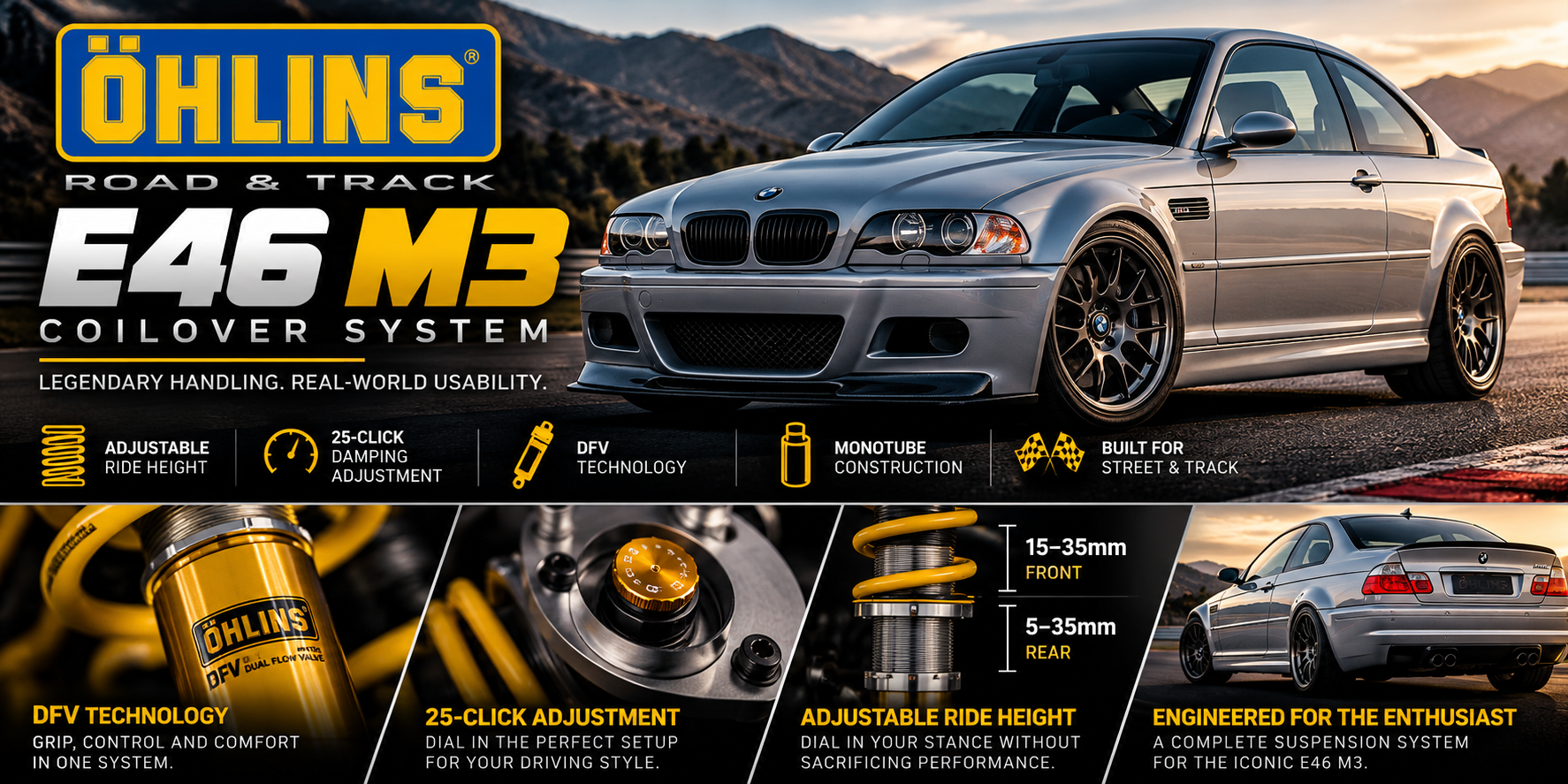
The E46 M3 is old enough that almost every suspension decision now has two parts.
First: how do you make the car handle better?
Second: how do you improve it without removing the balance that made the E46 M3 special in the first place?
That second question is what separates a good suspension build from simply making the car lower and stiffer.
The Öhlins Road & Track Coilover System for the 2001–2006 BMW E46 M3 is designed around exactly that compromise.
It gives the M3 adjustable damping, adjustable ride height, monotube dampers, inverted front struts, rebuildable construction, and Öhlins' Dual Flow Valve technology while remaining intended for a car that still sees normal roads.
For an E46 that needs to drive to the track, spend a weekend in the mountains, and still survive an imperfect commute, that distinction matters.
What Is the Öhlins Road & Track System?
Öhlins Road & Track is the company's dual-purpose performance suspension line.
The E46 M3 system is part number BMS MI30S1.
The E46 M3 Öhlins kit currently available through Elite Performance includes front and rear dampers, springs, ride-height adjustment, and adjustable damping.
Öhlins designed the system around a simple idea: a track-capable damper should not need to punish you every time you drive home.
Road and Track Really Means Both
A dedicated race suspension can prioritize lap time almost completely.
Ride comfort, potholes, expansion joints, passengers, and daily usability become secondary concerns.
A street suspension has the opposite problem. It needs to work through rough pavement and normal speeds without feeling nervous or excessively harsh.
Road & Track tries to cover both environments by giving the driver control over damping while using internal valve technology intended to respond differently to chassis movement and sharp road impacts.
What Is Öhlins DFV Technology?
DFV stands for Dual Flow Valve.
It is one of the defining features of Öhlins Road & Track dampers.
The shock absorber controls how quickly the suspension moves by forcing oil through internal valves.
Those valves determine how the damper reacts when the body rolls, pitches, compresses over a bump, or rebounds after the suspension is loaded.
The Problem With Simply Making a Shock Stiffer
A stiff damper can reduce body movement and make a car feel responsive on smooth pavement.
But if the damper is too restrictive when the tire hits a sharp bump, the wheel may have more difficulty moving out of the way quickly enough.
The result can be a harsh ride and, more importantly for performance, reduced tire contact with the road.
DFV Gives Oil Another Path
Öhlins uses its Dual Flow Valve system to manage oil flow during both compression and rebound.
The intent is to provide controlled chassis movement while allowing the suspension to react quickly when it encounters a sudden road imperfection.
That is why the system is marketed around both grip and comfort instead of treating those goals as completely incompatible.
How Adjustable Are the E46 M3 Öhlins Coilovers?
The system gives the driver control over both ride height and damping.
Öhlins currently specifies a 25-click damping adjustment range for the BMS MI30S1 system.
Damping Adjustment
Turning the adjuster changes the suspension's damping characteristics.
A firmer setting can provide additional body control for smooth roads and track use.
A softer setting can make the car more compliant on normal streets.
The important point is that the adjuster should be used deliberately.
More clicks toward stiff does not automatically mean more grip.
Ride-Height Adjustment
Öhlins lists approximately:
- 15–35 mm lowering range in front
- 5–35 mm lowering range in rear
That allows the owner to lower the E46 noticeably without forcing the car into an extreme stance-oriented ride height.
How Low Should You Set an E46 M3?
The lowest available position is rarely the best performance setting.
A suspension still needs travel.
Suspension Travel Matters
When the car is lowered, the body moves closer to the suspension's compression limits.
If the suspension runs out of travel during cornering or over a bump, it may contact the bump stop abruptly.
That sudden increase in effective spring rate can reduce grip instead of improving it.
Geometry Changes Too
Lowering changes the resting position of the control arms, tie rods, and other suspension components.
That can affect:
- Camber
- Toe
- Roll center
- Bump steer
- Available compression travel
The goal should be enough lowering to achieve the desired center of gravity, alignment, wheel clearance, and appearance without compromising the geometry the car needs to work properly.
What Spring Rates Does the E46 M3 Kit Use?
Öhlins currently specifies:
- 70 N/mm front spring rate
- 110 N/mm rear spring rate
The rear number is higher in part because the E46 uses a different suspension and spring arrangement at the rear.
You cannot compare the front and rear spring-rate numbers as though both springs act on the wheel in exactly the same way.
Spring Rate Is Only Part of Ride Quality
A common mistake is assuming a higher spring rate automatically means a worse ride.
Ride quality also depends heavily on:
- Damper tuning
- Tire sidewall
- Tire pressure
- Suspension travel
- Bump stops
- Bushing condition
- Road surface
A well-controlled spring and damper combination can feel more composed than a softer suspension that repeatedly bounces or crashes into its bump stops.
Why Use Monotube Dampers?
The Öhlins system uses monotube damper architecture.
In a monotube shock, the working piston operates within a single main cylinder with the oil and pressurized gas separated internally.
Heat Management
Hard driving creates heat inside a damper as the suspension repeatedly converts vehicle movement into hydraulic energy.
A monotube design can transfer that heat efficiently through the shock body.
That becomes particularly relevant during repeated track laps or extended aggressive driving.
Consistent Damping
As temperature changes, the damper still needs to behave predictably.
Keeping damping performance consistent is one of the major reasons serious performance suspension manufacturers pay so much attention to internal damper architecture.
Why Does the Front Use an Inverted Strut?
Öhlins uses an upside-down monotube front strut on the E46 M3 system.
This changes the way the strut is physically arranged compared with many conventional designs.
Additional Rigidity
An inverted strut can create a very rigid assembly, which is useful when the strut itself experiences lateral loads during cornering.
Unsprung-Mass Considerations
Damper architecture also affects which components move with the wheel and which remain associated with the chassis.
The entire suspension design—not just total component weight—determines how effectively the wheel can follow the road.
Will Öhlins Make the E46 M3 Harsh?
Not necessarily.
This is one of the main reasons people consider Road & Track instead of a more track-specific coilover.
Öhlins designed the system to provide a usable range that includes normal street driving.
Tire Choice Can Matter as Much as the Coilover
An E46 running a stiff-sidewall extreme-performance tire on a large wheel will feel very different from the same suspension paired with a more compliant street tire.
If ride quality matters, look at the complete package.
Do Not Start at Maximum Stiffness
Setting every adjuster to full stiff simply because the car has performance coilovers is usually a poor starting strategy.
Begin with the manufacturer's recommended baseline, drive the car, and make small changes based on what you actually feel.
What Happens When You Make the Dampers Too Stiff?
A damper needs to control the spring without preventing the wheel from following the surface underneath it.
Reduced Compliance
If the suspension cannot move quickly enough over bumps, the tire may temporarily lose some contact load.
That can reduce grip.
The Car May Feel Fast Without Being Faster
A very stiff suspension can make steering inputs feel immediate.
That sensation can feel sporty while the actual tire contact patch is becoming less consistent over imperfect pavement.
Good suspension tuning is about traction and control, not simply eliminating every bit of body movement.
What Happens When the Dampers Are Too Soft?
The opposite extreme creates its own problems.
Excessive Body Movement
The car may take longer to settle after:
- Braking
- Turn-in
- Acceleration
- Rapid direction changes
Poor Transition Control
A soft damper can allow the chassis to continue moving after the driver has already asked the car to do something else.
That can make the E46 feel less precise during quick left-right transitions.
The Correct Setting Is Road Dependent
A perfectly smooth circuit can tolerate—and sometimes reward—a firmer setting than a rough back road.
That is one of the main advantages of an adjustable system.
Do You Need Camber Plates?
The Öhlins E46 M3 Road & Track system is designed to work with the original upper mounts.
That makes the basic installation more street friendly.
But some builds may still benefit from adjustable camber hardware.
Street Car
If the goal is a responsive road car with reasonable tire wear, the factory adjustment range and original-style mounting arrangement may be sufficient depending on ride height.
Track Car
An E46 seeing repeated track use may need additional negative front camber to keep the outside front tire working effectively during hard cornering.
Camber plates can provide that adjustment.
More Camber Is Not Automatically Better
Excessive negative camber can reduce straight-line tire contact and increase uneven street wear.
Alignment should be chosen around how the car is actually used.
Why Alignment Matters After Installing Coilovers
Ride-height changes alter suspension geometry.
An alignment should therefore be treated as part of the coilover installation.
Toe Is Especially Important
Incorrect toe can destroy expensive tires surprisingly quickly.
A lowered car that appears visually straight can still have enough toe error to create serious wear.
Corner Balance for Serious Builds
If the E46 is being prepared for track use, corner balancing can take the setup further.
Corner balancing measures how the vehicle's weight is distributed across the four tires and uses ride-height adjustments to refine that distribution.
This is not necessary for every street M3, but it becomes much more relevant when extracting maximum chassis performance is the goal.
Do Coilovers Fix Worn E46 Suspension Bushings?
No.
This is particularly important on a car that may now be more than twenty years old.
A premium damper cannot compensate for every worn joint surrounding it.
Inspect the Chassis First
Before installing the Öhlins kit, inspect components such as:
- Front control-arm bushings
- Ball joints
- Tie rods
- Rear trailing-arm bushings
- Rear shock mounts
- Sway-bar links
- Wheel bearings
If those parts have significant play, the car can still feel vague or unstable no matter how expensive the dampers are.
What About the E46 Rear Subframe?
Any serious E46 M3 suspension build should acknowledge the platform's well-known rear-floor and subframe-mounting concerns.
Changing suspension performance does not create the issue by itself, but a high-grip modified car can place significant loads through an aging chassis.
Inspect Before Building Around It
If the car has never had the rear mounting structure inspected, suspension work is a good reason to evaluate it.
Track use, sticky tires, and harder driving increase the importance of knowing the chassis underneath the suspension is healthy.
Öhlins vs. Lowering Springs
Lowering springs and coilovers solve different problems.
Lowering Springs
A spring kit is generally less expensive and can:
- Reduce ride height
- Reduce wheel gap
- Change spring rate
- Improve body control when matched properly to the dampers
But the original damper still determines much of the suspension's behavior.
Öhlins Road & Track
The Öhlins E46 M3 system changes the spring and damper package together.
It also adds ride-height and damping adjustment.
For an owner who wants substantially more chassis control instead of mainly changing stance, that is a much more comprehensive approach.
Öhlins vs. a Track-Only Coilover
If the car is becoming a dedicated competition vehicle, a more specialized damper may eventually make sense.
But specialization creates tradeoffs.
Dedicated Track Setup
A competition-oriented system may offer:
- More damping adjustment
- Remote reservoirs
- More aggressive spring rates
- More track-focused geometry options
- Greater tuning complexity
Road & Track Setup
The Öhlins system is intentionally more approachable.
It gives an enthusiast meaningful adjustment while retaining a usable street-driving window.
For a car that still has license plates and regularly drives to the circuit instead of arriving on a trailer, that can be a better match.
Does the E46 Need Coilovers to Be Fast?
No.
A healthy stock E46 M3 already has a capable chassis.
Good tires, proper alignment, fresh bushings, good brakes, and a competent driver can make an enormous difference.
Coilovers Make Sense When You Want More Control
A premium coilover becomes valuable when you want to:
- Control ride height
- Tune damping
- Improve repeated-use damper performance
- Balance street and track settings
- Build the chassis around a more serious tire package
The suspension should support the rest of the build rather than becoming an expensive modification installed because coilovers are expected on a modified M3.
What Tires Should You Run With Öhlins?
The suspension can only work with the grip the tires provide.
Street Performance Tire
A quality summer-performance tire can give the suspension enough grip to make the improved chassis control noticeable without turning every road trip into a competition event.
Track Tire
A more aggressive tire can raise the available cornering load substantially.
That may justify changes to damping, alignment, brake setup, and tire pressures.
Do Not Tune the Suspension in Isolation
If you change from a compliant street tire to a very stiff track-focused tire, the car may need different damper settings even though nothing changed in the coilovers themselves.
The tire is part of the suspension system.
What About Wheels?
Wheel width, offset, diameter, and weight all influence how the suspension behaves.
Wheel Width
A wider wheel can support a wider tire, but it also changes inner and outer clearance.
Wheel Diameter
Larger wheels generally reduce tire sidewall when overall diameter remains similar.
That changes how much compliance the tire itself contributes.
Wheel Weight
Heavy wheels increase unsprung and rotational mass.
That gives the suspension more mass to control every time the tire travels over a bump.
A chassis-focused E46 build should treat the wheel, tire, and suspension as one package.
Can You Daily Drive an E46 M3 on Öhlins?
That is one of the strongest arguments for the Road & Track system.
Öhlins specifically designs the line to retain a road-usable setting.
The car will still be modified, and ride quality will depend heavily on ride height, damping setting, tires, and the condition of the rest of the chassis.
But this is not a suspension designed only around a smooth race circuit.
Start With a Conservative Height
A moderate drop preserves more suspension travel and ground clearance.
Start With the Recommended Damper Setting
Do not assume the hardest setting is the enthusiast setting.
Tune From There
Make small changes, drive the same familiar road, and pay attention to:
- Turn-in
- Mid-corner stability
- Bump absorption
- Rear traction
- Body movement
Change one variable at a time.
What Makes a Rebuildable Damper Valuable?
Öhlins Road & Track dampers are rebuildable.
That matters on a car many owners plan to keep long term.
Dampers Are Wear Components
The seals, oil, and internal components of a shock absorber experience repeated motion and heat.
Eventually, performance changes.
Rebuilding Extends the System's Life
Instead of treating the entire coilover assembly as disposable, a rebuildable damper can be serviced.
It can also potentially be revalved for a different spring or intended use by an appropriate suspension specialist.
For a long-term E46 build, serviceability can be as important as the initial specification sheet.
What Should You Check Before Ordering?
Before ordering the Öhlins system, confirm:
- Exact BMW M3 model year
- Coupe or convertible body style
- Current suspension modifications
- Condition of suspension bushings and joints
- Rear shock-mount condition
- Rear subframe/floor condition
- Wheel size and offset
- Tire dimensions
- Desired final ride height
- Street vs. track use
- Alignment goals
Convertible Owners Need Extra Attention
Öhlins notes that the BMS MI30S1 system fits E46 M3 coupes directly and that convertible applications require a small change to the rear upper mounts.
That is exactly the kind of detail worth confirming before the car is already disassembled.
Is the Öhlins Road & Track System Worth $3,000?
That depends on what you want from the E46.
If your main goal is simply reducing wheel gap, there are much less expensive ways to lower the car.
If the goal is to transform chassis control while maintaining enough compliance to keep using the M3 on real roads, the argument becomes much stronger.
The Öhlins BMS MI30S1 Road & Track system gives you:
- Dual Flow Valve technology
- Adjustable damping
- Adjustable ride height
- Monotube dampers
- Inverted front struts
- Rebuildable construction
- A suspension designed around both street and track use
That makes it more than an expensive lowering kit.
It is a complete damper-and-spring system intended to change how the car controls its tires.
Build the E46 Around Balance, Not Just Stiffness
The E46 M3 became an enthusiast icon because it balances feedback, grip, power, and chassis movement extremely well.
A suspension upgrade should build on that balance rather than simply removing every bit of movement from the car.
If your M3 is becoming a serious dual-purpose road and track build, start with the Öhlins Road & Track Coilover System for the E46 M3.
You can also browse Ohlins performance parts at Elite Performance or compare the complete Ohlins suspension lineup if you are building another platform.
For brakes, chassis components, maintenance parts, and the rest of the car, browse the BMW M3 parts catalog at Elite Performance.
The goal should not be to make the E46 feel like every modern track build.
It should be to make the E46 better at being an E46.